

Undertone is one of the first things people hear about in color analysis, and also one of the easiest things to get wrong.
You may have been told to check your veins, think about if you burn or tan, or decide if gold or silver jewelry looks better. Those tests sound useful because they give a fast answer. The problem is that undertone is more nuanced than that.
In personal color analysis, undertone describes where your natural coloring sits on a cool-to-warm spectrum. It helps explain why two people with similar skin depth can need very different colors near their face.
You can be fair and warm. You can have deep skin and cool coloring. You can have olive skin without being warm. And blue eyes do not automatically make you cool.
The useful question is not, “Do I look pink or yellow?”
It is, “How much warmth can I actually see in my natural coloring?”
Table of Contents
What Is Undertone in Color Analysis?
Undertone is the temperature of your natural coloring.
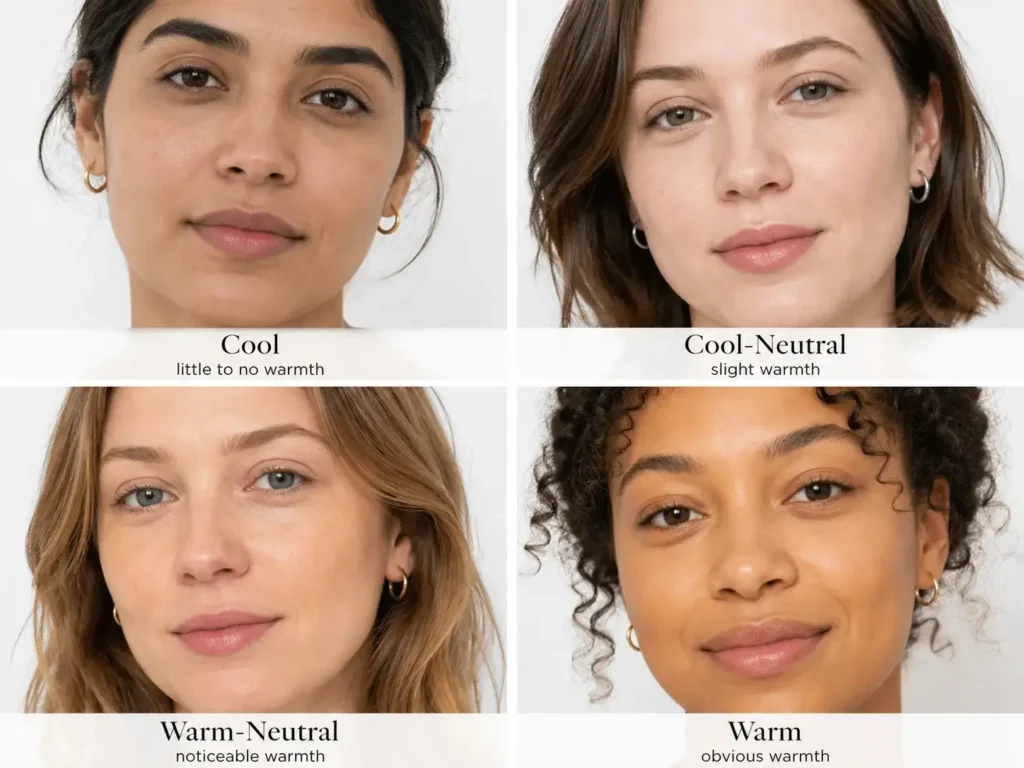
For this color analysis system, there are four useful categories:
- Cool: little to no visible warmth
- Cool-neutral: a small amount of warmth
- Warm-neutral: clear warmth, but not enough to look fully warm
- Warm: obvious warmth
Think of these as points along one continuous scale rather than four boxes with hard borders.
At one end, you have coloring with very little visible warmth. At the other, warmth is immediately clear. Most people sit between those two ends, which is why cool-neutral and warm-neutral are so important.
It also explains why simply asking, “Am I warm or cool?” can make color analysis harder than it needs to be.
You may not be strongly either one.
How Undertone Connects to the Color Seasons
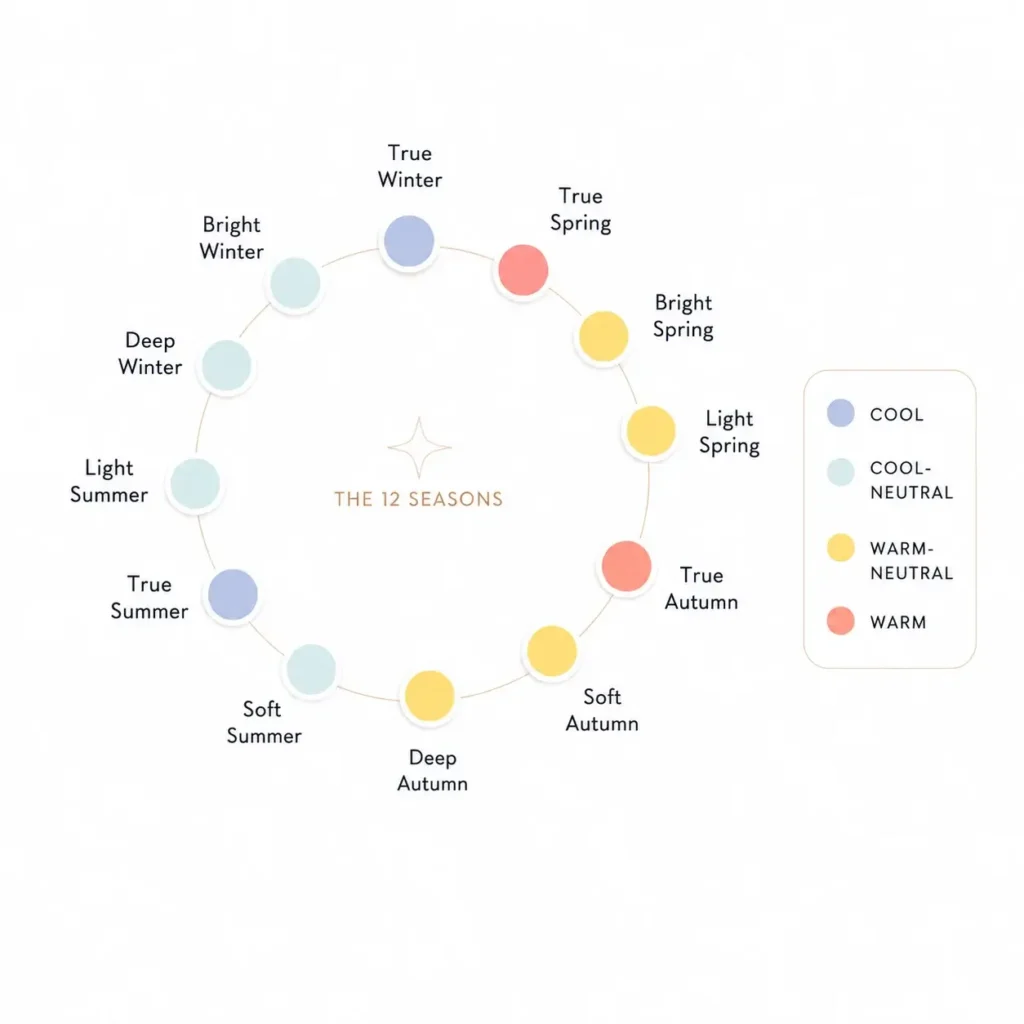
In a 12-season color system, the four True seasons sit closest to the ends of the temperature spectrum.
- True Summer and True Winter are cool.
- True Spring and True Autumn are warm.
The remaining seasons lean cool or warm, but temperature is not their strongest feature.
Cool-neutral seasons include:
- Soft Summer, Light Summer, Deep Winter, and Bright Winter.
Warm-neutral seasons include:
- Soft Autumn, Deep Autumn, Light Spring, and Bright Spring.
So someone can belong to Autumn without having strongly warm coloring, or belong to Winter without looking obviously cool.
It matters because your best colors usually follow the same temperature direction as your natural coloring. Strongly warm coloring tends to work best with clearly warm versions of colors. Cool-neutral coloring usually needs colors that lean cool without becoming extremely icy.
Skin Tone and Undertone Are Not the Same Thing
Skin tone describes how light or deep your skin appears.
Undertone describes the skin’s color temperature.
Someone with very fair skin can be warm, cool, or somewhere between. The same is true for medium and deep skin.
Sun exposure can also change how light or deep your skin looks without giving you a new color-analysis category.
It is also worth separating undertone from the Fitzpatrick skin phototype system. Fitzpatrick types were developed around how skin responds to UV exposure, especially tanning and burning. They were not created to classify personal color temperature.
That is why “I tan easily, so I must be warm” does not work as an undertone rule.
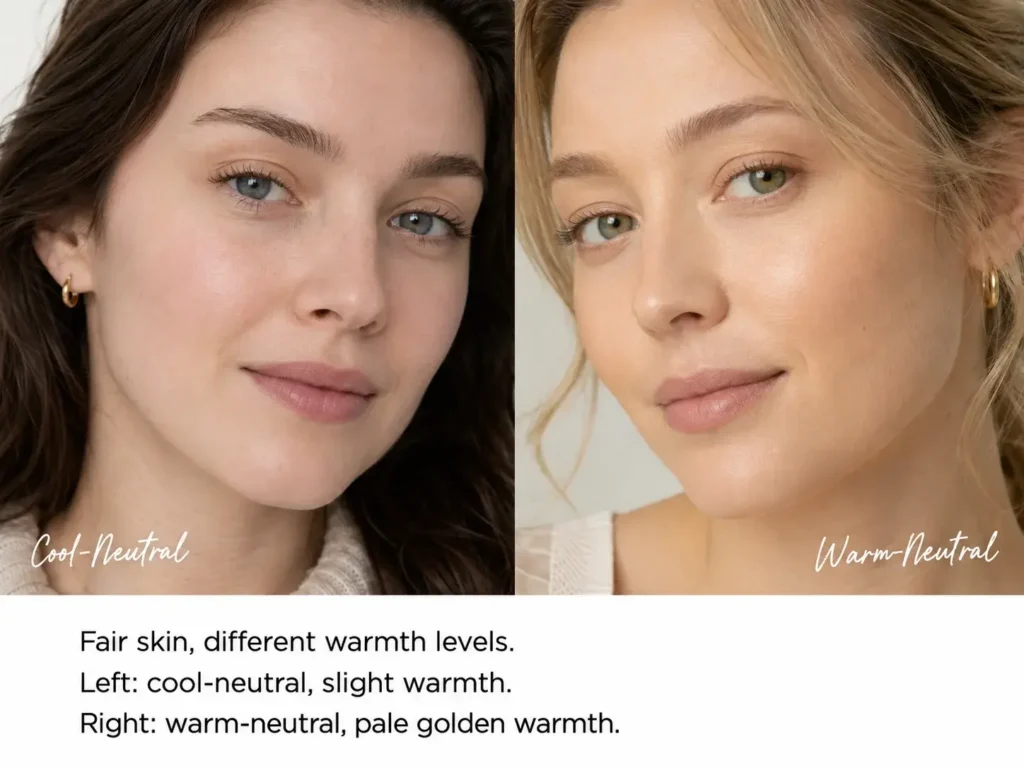
What Creates the Color We See in Skin?
Skin color is more complex than one pigment.
Melanin is a major factor. Human skin contains two main forms, eumelanin and pheomelanin. Eumelanin is brown to black, while pheomelanin is yellow to red. Their amount, type, and distribution contribute to the color we see.
Skin appearance is also affected by other components, including hemoglobin and carotene. That is one reason visible redness or yellowness cannot automatically be treated as your undertone.
Personal color analysis takes that complicated biology and turns it into a practical visual question: how warm does your natural coloring appear compared with coloring that is cooler?
For this method, the warmth you are looking for in skin reads more like an orange cast than simple yellow.
That distinction matters.
Warmth in Skin Is Not the Same as Yellowness
This is where many undertone guides cause confusion.
Yellow skin is often labeled warm immediately. Olive skin is often treated the same way.
But yellow does not always read warm in color analysis.
A complexion can have a noticeable yellow or olive cast and still look cooler than another complexion of similar depth. What matters is if that yellow moves toward orange warmth or stays more green, muted, or neutral in appearance.
Imagine two medium skin tones.
One looks golden-orange, caramel, or coppery.
The other looks yellow-green, muted olive, or more neutral brown.
Both may contain plenty of yellow visually, but the first reads warmer.
So when judging your skin, do not ask only:
“Do I see yellow?”
Ask:
“Does my skin have an orange warmth to it?”
What Cool Skin Actually Looks Like
Cool skin does not need to look blue or pink.
In fact, looking for blue skin is not very useful.
Cool coloring is better understood by its lack of visible orange warmth.
Some cool complexions look muted or slightly gray. Others have an olive cast. Some medium or deep cool skin can look red-brown rather than orange-brown. Fair cool skin may appear almost translucent because blood vessels and surface redness are easier to see.
The common link is not one specific color.
It is the absence of clear orange warmth.
Cool Undertone
A cool undertone has almost no visible warmth.
Depending on your skin depth, this may show up as:
- a muted or desaturated complexion
- a green-leaning olive tone
- a cooler brown tone
- a red-brown or mahogany cast in deeper skin
- fair skin with very little golden or peach color
Cool skin does not have to look pink. It simply does not carry much obvious orange warmth.
Cool-Neutral Undertone
Cool-neutral coloring has a little warmth, but still leans cooler overall.
This is close to what many people mean when they call themselves “neutral.”
Your skin might not look obviously cool. It may have a little golden or peach color, but that warmth does not dominate.
Olive skin often falls here because an olive cast can create a mix that does not fit the usual pink-versus-yellow rules.
When someone says both warm and cool colors seem to work, but the coolest or warmest shades feel slightly wrong, cool-neutral or warm-neutral coloring is often worth checking.
Warm-Neutral Undertone
Warm-neutral coloring has noticeable warmth without reaching the clear warmth seen in a fully warm undertone.
Your complexion may have:
- soft golden warmth
- a light peach cast
- subtle caramel or copper tones
- a brown shade that leans gently orange
Warm-neutral people often wear warmer colors well, but may find that extremely warm mustard, orange, or yellow-heavy colors are too much.
This is why identifying the amount of warmth matters more than simply labeling yourself warm.
Warm Undertone
A warm undertone contains obvious warmth.
- In lighter skin, this can look golden, apricot, or peach.
- In medium skin, it may appear ocher, caramel, amber, or ginger.
- In deeper skin, it may show as copper, cinnamon, tawny, or rich orange-brown.
You should be able to see the warmth without searching for it.
That is the key difference between warm and warm-neutral coloring.
Olive Skin Can Be Cool or Warm
Olive skin causes a lot of confusion because people often use “olive” and “warm” as though they mean the same thing.
They do not.
Olive describes a visible greenish or yellow-green quality in the skin. That does not tell you how much orange warmth is present.
- A cooler olive complexion may look greenish, muted, or slightly gray.
- A cool-neutral olive complexion may have a softer olive cast with a little warmth.
- A warmer olive complexion will have the olive quality plus a clearer golden-orange or bronzed warmth.
So olive is not a fifth temperature sitting beside cool, neutral, and warm. It is a skin color quality that can appear at different points on the temperature scale.
And it is not limited to medium skin. Olive coloring can appear in light and deeper complexions as well.
Pink Skin Does Not Automatically Mean Cool
Pinkness is another common source of wrong results.
Your cheeks may be pink because of flushing, sensitivity, irritation, acne, temperature, or visible blood vessels. Surface redness is not the same thing as the underlying color you are trying to assess.
This matters most in fair skin, where blood and blood vessels can affect what you see more clearly. Hemoglobin contributes to visible skin color, especially in lighter skin.
When checking undertone, look at the overall facial skin rather than one red area.
Ignore temporary redness around the cheeks, nose, blemishes, or irritated areas.
A fair complexion can certainly be cool, but pink cheeks alone do not prove it.
Undertone Across Different Skin Depths
There is no skin depth that belongs to one temperature.
Fair and Light Skin
Fair and light skin can range from cool to warm.
- Cool skin may look muted, pale olive, slightly pink overall, or almost free of golden color.
- Cool-neutral skin has a small amount of warmth.
- Warm-neutral skin may have a soft peach or gold cast.
- Warm skin has clearer apricot, peach, or golden-orange warmth.
Do not assume pale skin is cool simply because it looks light.
Light-Medium and Medium Skin
Medium skin often makes temperature easier to see because more color is visible.
- Cool skin may look olive, muted, or cooler brown.
- Cool-neutral skin can have a softer olive or balanced brown quality.
- Warm-neutral skin may show caramel, bronze, or copper hints.
- Warm skin can carry clearer ocher, amber, ginger, caramel, or orange-brown warmth.
Again, yellow alone does not settle the question. Compare how close the skin feels to green-yellow versus golden-orange.
Deep and Rich-Deep Skin
Deep skin can also sit anywhere along the temperature scale.
The visual differences may appear in the quality of the brown rather than in obvious pink or yellow.
- A complexion may look more muted, espresso-like, olive-brown, red-brown, neutral brown, copper, cinnamon, tawny, or chestnut.
The goal is still the same: compare the amount of visible warmth.
Do not use skin depth as a shortcut for undertone.
Can Freckles Help?
Sometimes.
Freckles can give you another clue because their color may show warmth more clearly than the surrounding skin.
- Warmer coloring may have freckles that look coppery or orange-brown.
- Cooler coloring may have freckles that look more muted or gray-brown.
Treat freckles as supporting evidence, not your whole result.
Does Hair Matter for Undertone?
Yes, but less than skin.
Natural hair color can support what you see in your complexion. Hair color, like skin pigmentation, is strongly affected by eumelanin and pheomelanin. Darker hair generally contains more eumelanin, while red hair contains much more pheomelanin than typical brown or blond hair.
The problem is that warmth is not always easy to see in natural hair.
- Very dark hair can contain warm pigment without looking warm because the hair is too deep for that warmth to stand out.
- Very light hair can also be difficult to judge because there is little pigment overall.
So use hair as extra evidence, not as the main test.
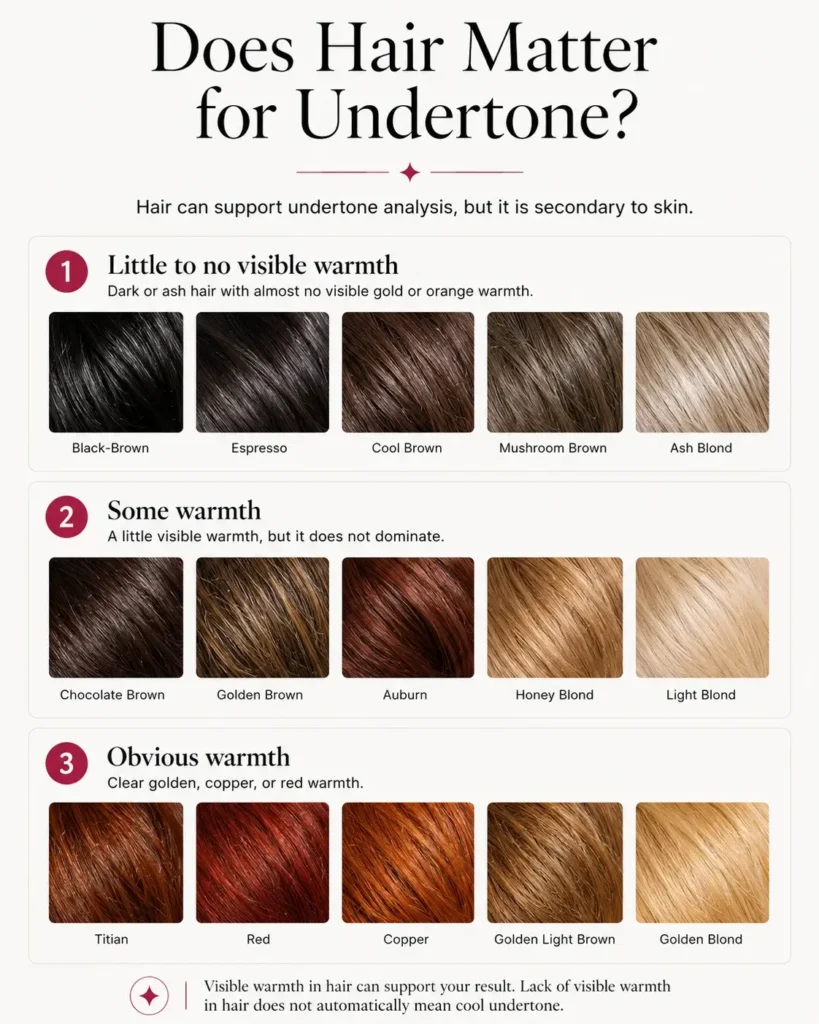
How to Read Warmth in Natural Hair
Look at your natural hair near the crown, not sun-lightened ends or dyed sections.
Little to No Visible Warmth
This may include:
- black or black-brown hair
- deep brown without gold, amber, or bronze
- cool medium brown
- ash brown
- ash blond
Do not worry if dark brown hair shows a slight reddish reflection under strong light. A reflection is not the same as obvious overall warmth.
Some Warmth
This can include:
- bronzy brown
- golden brown
- cinnamon brown
- auburn
- medium or light blond with a gentle golden cast
Here, warmth is noticeable but does not dominate the entire color.
Obvious Warmth
This includes hair where gold, copper, orange, or red is one of the first things you notice.
Examples include:
- copper hair
- red hair
- strawberry blond
- deep red-orange hair
- honey blond
- golden light brown
Naturally red hair is especially useful evidence because red hair is strongly linked with differences in melanin production and MC1R variants.
Why the Absence of Warm Hair Does Not Make You Cool
Suppose your skin looks clearly warm, but your natural hair is very dark brown and appears neutral.
That does not cancel the warmth in your skin.
Deep hair contains enough eumelanin that subtler warm pigment may be hard to see. This is why skin carries more weight when your evidence does not match.
Visible warmth in the hair is useful.
No visible warmth in the hair is much weaker evidence.
Ignore Sun-Lightened Hair
Natural does not always mean unchanged.
Hair around the face, the ends, and the outer layers can become lighter from UV exposure. As hair lightens, its color can look warmer than the less exposed hair near the roots.
For undertone, check the most natural, least altered part of your hair.
The same applies after highlights, dye, bleach, glosses, henna, or other color treatments.
Your current hair color may affect which clothes look balanced on you, but it should not replace your natural coloring when you are identifying your base season.
What About Facial Hair?
Beards can sometimes look noticeably redder or warmer than scalp hair.
Research has found body-site differences in hair color, including beard hair that can appear redder than scalp hair, with MC1R playing a role in some of that variation.
So if your beard is coppery but the hair on your head is clearly cooler, do not let the beard decide your overall undertone.
Use scalp hair with your skin instead.
Does Eye Color Tell You Your Undertone?
No.
Blue eyes do not make someone cool. Brown eyes do not make someone warm.
Two people can have similar blue eyes while one has clearly warm skin and copper hair and the other has cool skin with brown hair.
Eye color is influenced by the amount and type of pigment in the iris, along with how light interacts with its structure. Research also shows that iris pigmentation involves both eumelanin and pheomelanin, so the simple claim that eyes contain only one form of melanin is not accurate.
The practical point for color analysis is simpler: eye color is not a dependable substitute for reading temperature in your skin and hair.
Your eyes become more useful later when looking at contrast, depth, and how clear or muted your overall coloring appears.
The Vein Test Is Not a Reliable Undertone Test
You have probably seen this rule:
- Blue veins mean cool.
- Green veins mean warm.
- A mix means neutral.
Do not build your result around it.
The color you see through the skin depends on several things, including skin depth, optical effects, lighting, and the tissue above the blood vessels.
Even the visible color of skin itself comes from several contributors, not one pigment.
Your veins may be blue, green, turquoise, purple, or difficult to see at all.
That does not give you a clean reading of your color-analysis undertone.
Tanning and Burning Do Not Tell You Your Undertone Either
Another common rule says:
- People who burn are cool.
- People who tan easily are warm.
This mixes two different ideas.
Burning and tanning describe how your skin responds to UV exposure. That is the type of behavior the Fitzpatrick phototype system was built around. It is not a personal color temperature test.
A cool-toned person may tan. A warm-toned person may burn. Use your actual coloring, not your vacation history.
Is the Gold vs Silver Jewelry Test Useful?
It can be useful as a comparison, but it should not make the final call.
- You might prefer gold because you like gold. The design, finish, size, brightness, or clothes you are wearing can also affect which metal looks better.
What makes jewelry useful is not the metal label. It is your face’s reaction.
Does one metal make the skin look clearer and more even?
Does the other create a yellow, gray, red, or flat cast?
That reaction can support your result, but fabric draping gives you much more color to compare.
The Best Practical Test: Compare Colors Near Your Face
Once you have looked at your skin and natural hair, test your result with fabric.
Do this in natural daylight, without colored light reflecting onto your face. Keep makeup minimal or remove it so you can see your skin clearly. Pull dyed hair away from your face when possible.
- Start with a clear temperature comparison.
- Try a cooler blue, blue-red, cool pink, or cool gray.
- Then try a warmer orange, coral, warm red, camel, or warm cream.
- Do not ask which color you like.
- Watch your face.
A better temperature can make the complexion look more even, bring attention to the eyes, and keep facial features clear.
A poor temperature can make shadows, redness, yellowness, or uneven areas appear stronger. Sometimes the color itself gets attention before your face does.
Compare several pairs before reaching a conclusion.
One shirt is not enough evidence.
How to Find Your Undertone Step by Step
- Start with your facial skin.
- Ignore temporary redness, dry darker areas, makeup, fake tan, and obvious sun exposure.
- Ask how much orange warmth you can see.
- If there is almost none, start with cool.
- If there is a little, start with cool-neutral.
- If there is clear but moderate warmth, start with warm-neutral.
- If the warmth is obvious, start with warm.
- Then check your natural scalp hair.
- Visible gold, copper, bronze, orange, or red warmth can move your result warmer.
- Hair with little visible warmth does not automatically move you cooler.
- Finally, test your best two possibilities with fabric near your face.
You do not need to force yourself into one category immediately. Getting down to two likely options is useful progress.
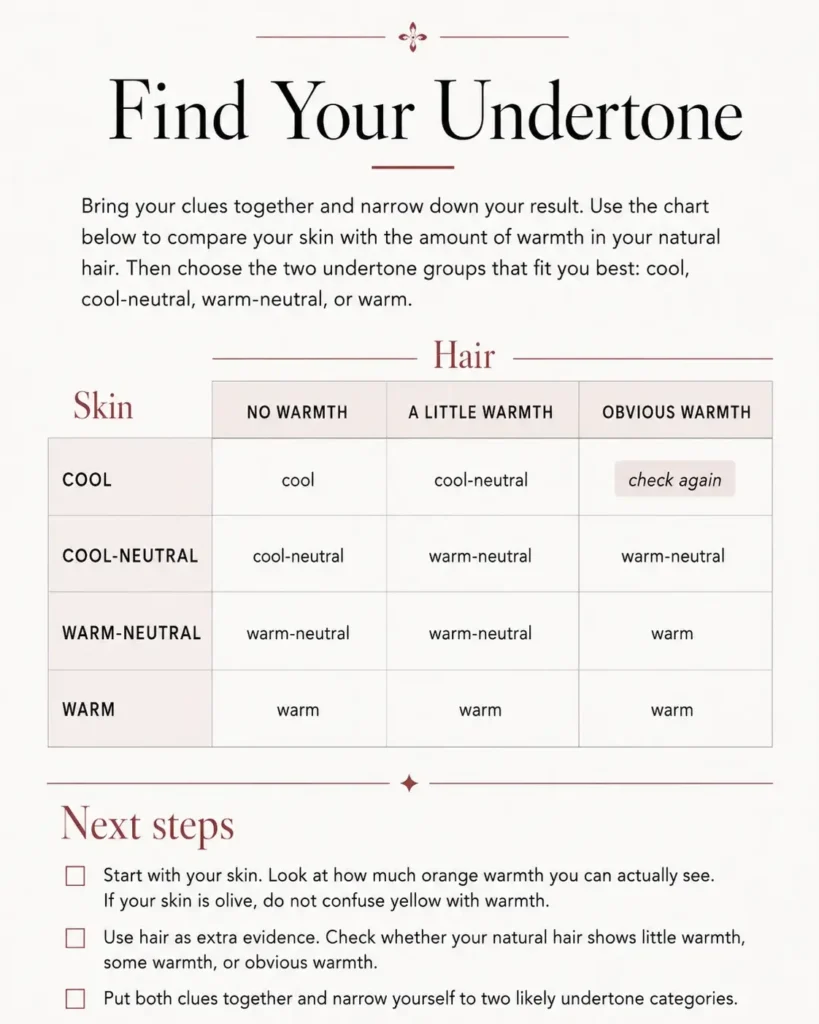
A Simple Way to Combine Skin and Hair
Let skin lead.
Then let hair add evidence.
- Cool skin + hair with little warmth: cool is likely.
- Cool skin + some hair warmth: compare cool and cool-neutral.
- Cool-neutral skin + little hair warmth: cool-neutral is likely.
- Cool-neutral skin + noticeable hair warmth: compare cool-neutral and warm-neutral.
- Warm-neutral skin + little hair warmth: warm-neutral can still fit.
- Warm-neutral skin + obvious hair warmth: compare warm-neutral and warm.
- Warm skin: warm remains the strongest starting point even if dark hair does not show much warmth.
The skin matters more because hair depth can hide temperature.
What If You Seem Completely Neutral?
Many people expect neutral to mean exactly halfway between warm and cool.
In seasonal color analysis, a better question is which direction you lean.
You may be only slightly cool.
You may be only slightly warm.
That small lean can be enough.
If neither temperature dominates your coloring, another quality may matter more, such as being light, deep, soft, or bright. That is where the neutral-leaning seasons come in.
Your temperature still matters, but it does not have to be your strongest trait.
Your Undertone Does Not Limit You to Certain Colors
Warm undertone does not mean you can only wear brown, orange, and yellow.
Cool undertone does not mean your wardrobe has to be blue and purple.
- Nearly every hue has warmer and cooler versions.
- A warm green might lean yellow or olive.
- A cooler green might lean blue.
- A warm red can move toward tomato or coral.
- A cool red can move toward berry or blue-red.
- A warm pink might lean peach.
- A cooler pink might lean rose or raspberry.
The goal is not to remove colors from your wardrobe. It is to find the version of each color that works best with your coloring.
Why Undertone Matters in Color Analysis
Once your undertone is clear, many color choices get easier.
You can compare clothing colors with more purpose.
You can understand why one beige makes you look clear while another looks dull.
You can choose makeup shades that sit more naturally with your skin.
You can make more informed hair color choices.
Most importantly, undertone helps narrow your seasonal color options.
But it is only one part of color analysis.
A complete season also depends on factors such as depth, chroma, and contrast.
Someone can have the same undertone as you and still need a very different palette.
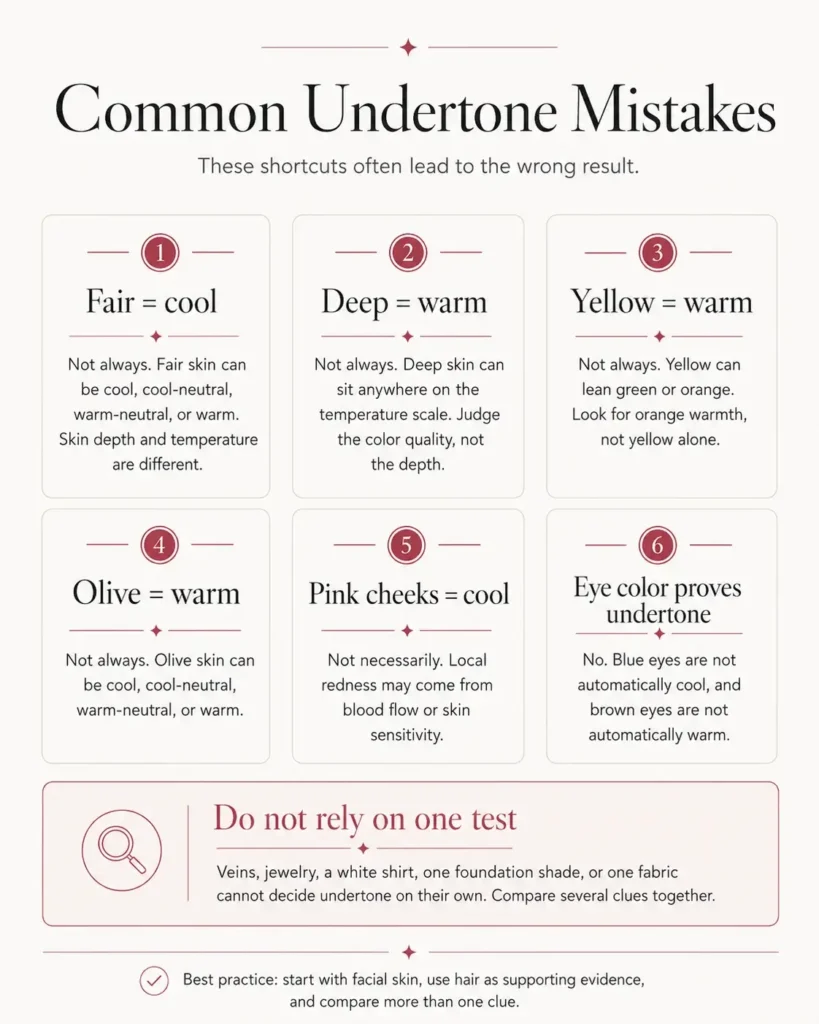
Common Undertone Mistakes
Quick Undertone Check
Ask yourself these questions in natural light:
- How much orange warmth can I see in my facial skin?
- Does my skin look more muted, olive, balanced, golden, peach, copper, or orange-brown?
- Am I mistaking yellow or redness for warmth?
- Does my natural scalp hair contain visible gold, bronze, copper, orange, or red warmth?
- Do warm or cool fabrics make my complexion look clearer and more even?
- Which two categories fit me best: cool, cool-neutral, warm-neutral, or warm?
That last question is more useful than forcing a perfect answer on the first try.
Final Takeaway
Undertone is not about finding one hidden pink, yellow, or blue pigment in your skin.
In color analysis, it is a comparison of how cool or warm your natural coloring appears.
Start with your facial skin. Look for the amount of visible orange warmth rather than relying on yellowness, redness, veins, tanning, or skin depth. Then use your natural hair as extra evidence and confirm the result by comparing warm and cool colors near your face.
You may end up clearly cool or warm. You may sit much closer to the middle as cool-neutral or warm-neutral.
Both are useful answers.
Once you know which direction your coloring leans, finding your season becomes much easier.