

Feeling like your wardrobe just doesn’t work for you? Maybe the colors seem off, or your clothes don’t quite make you feel confident. Nothing is in harmony with your natural features?
Let me help you discover your personal style and perfect colors that complement your skin, eyes, and hair. The colors that make your complexion glow and your eyes pop.
About color analysis, you might have heard of the 4-season system, which divides people into spring, summer, autumn, and winter.
Then there’s the 12 and 16 season system, which adds further categories. All of this might sound overwhelming, but stay with me, and I’ll try to break it down in easy terms.
You can explore seasons, identify your color profile, and simplify your wardrobe choices. Let’s start!
Table of Contents
Foundational Elements of Color
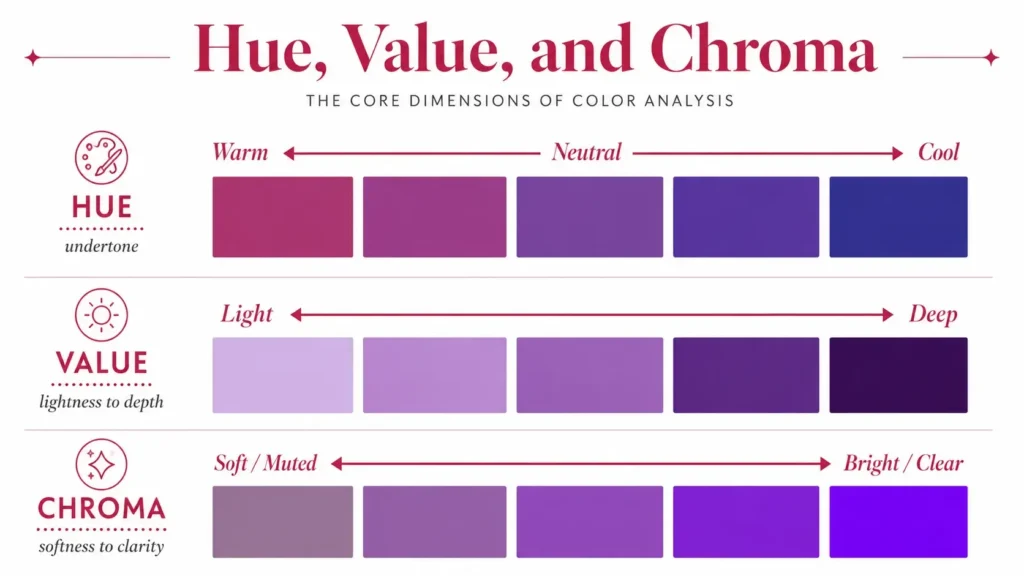
Here are the elements (along with draping) that work together and define the colors that harmonize with your natural features.
1. Hue (Undertone)
Hue refers to the inherent temperature of your skin. It can be warm, cool, or neutral.
Warm undertones have yellow, gold, or peach hues. Cool undertones have pink or blue hues. Neutral undertones are a mix of both.
You can do vein test, jewelry test, or hold a white paper near your face. Analyze your colors in natural daylight, without makeup, and against a neutral background for accurate assessment.
2. Value
Value refers to the lightness or darkness of your natural coloring, skin, hair, and eyes. The dimension helps determine the depth of colors in your palette.
- Light Value: Very fair skin, light blonde hair, light eyes.
- Deep Value: Deep skin tone, dark hair, dark eyes.
It impacts the contrast levels that flatter you. For instance, high-contrast combinations may suit those with deep value. The lower-contrast pairings may be better for light value individuals.
3. Chroma (Intensity)
Chroma measures the intensity or purity of a color. How muted or clear/saturated your natural coloring is.
- Soft/Low Chroma: Muted, blended features.
- Bright/Clear/High Chroma: Vivid, sparkling features.
This dimension dictates the intensity of colors that look best on you. High-chroma individuals shine in clear, vivid colors. Low-chroma individuals look best in soft, muted tones.
From 4 to 16 Season Colors
Color analysis system helps you find which colors harmonize best with your skin tone, hair color, and eye color. You can identify complementary colors, and the journey begins with the 4-season system. It classifies individuals into spring, summer, autumn, or winter based on their undertone: warm or cool.
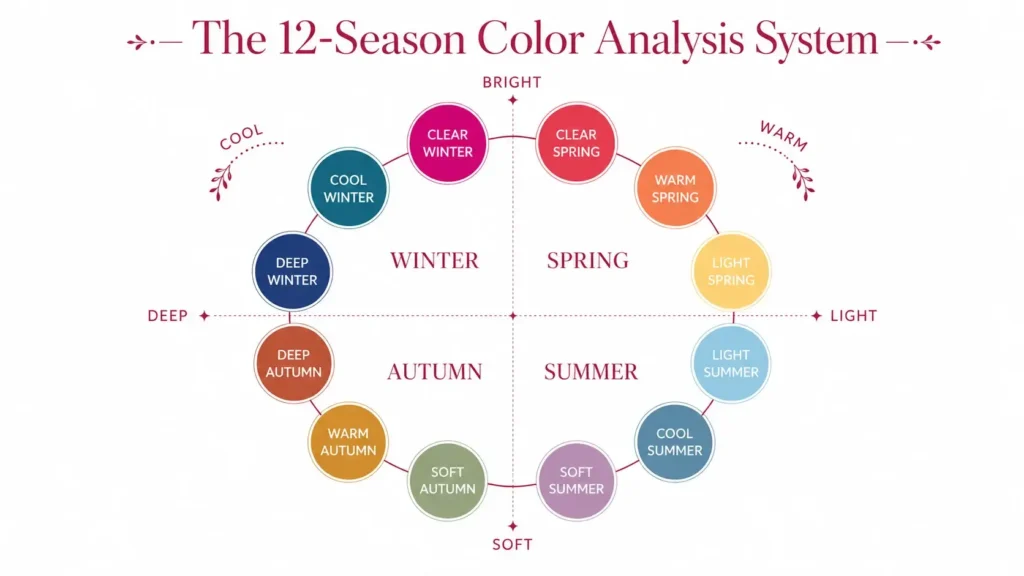
The 12-season system divides each of the four seasons into three subcategories based on a dominant characteristic:
- Spring: Light Spring, Warm Spring, Clear Spring.
- Summer: Light Summer, Cool Summer, Soft Summer.
- Autumn: Warm Autumn, Deep Autumn, Soft Autumn.
- Winter: Cool Winter, Clear Winter, Deep Winter.
The 16-season system further refines the analysis and consider all three dimensions: hue, value, and chroma, in balance. There are precise categories, such as “True” seasons, which accommodate individuals whose features don’t fit neatly into one season. For example, someone might be a “True Autumn,” characterized by warm, deep, and muted tones.
The 16-Season Color Analysis System
Here are 16 colors at a glance, based on sci-art interpretation.
a. Spring Family
| Season | Dominant Trait | Undertone | Value | Chroma | Key Characteristics |
|---|---|---|---|---|---|
| True Spring | Balanced warm-bright | Warm | Medium–Light | Bright | Even warmth, moderate contrast. Core Spring palette. |
| Warm Spring (a.k.a. Golden Spring) | Warmest Spring | Warm | Medium | Bright | Golden, rich warmth; leans toward Autumn hues. |
| Light Spring | Lightest Spring | Warm | Light | Soft–Bright | Delicate, pastel-leaning warmth. |
| Bright Spring (Clear Spring) | Most vivid Spring | Warm | Medium | Brightest | High contrast and saturation. Leans toward Winter brightness. |
b. Summer Family
| Season | Dominant Trait | Undertone | Value | Chroma | Key Characteristics |
|---|---|---|---|---|---|
| True Summer | Balanced cool-soft | Cool | Medium–Light | Soft | Classic Summer look, muted cool tones. |
| Cool Summer | Coolest Summer | Cool | Medium | Soft | Leaning cooler and deeper than True Summer. |
| Light Summer | Lightest Summer | Cool | Light | Soft | Airy, pastel-like coolness. |
| Soft Summer | Most muted Summer | Cool | Medium | Muted | Low contrast, cool neutral softness. |
c. Autumn Family
| Season | Dominant Trait | Undertone | Value | Chroma | Key Characteristics |
|---|---|---|---|---|---|
| True Autumn | Balanced warm-muted | Warm | Medium–Deep | Soft | Earthy richness, warm, soft tones. |
| Warm Autumn | Warmest Autumn | Warm | Medium–Deep | Soft | Golden-leaning deep warmth. |
| Deep Autumn | Deepest Autumn | Warm | Deep | Soft–Rich | Strong depth, rich warm tones. |
| Soft Autumn | Most muted Autumn | Warm | Medium | Muted | Dusty, gentle, blended warmth. |
d. Winter Family
| Season | Dominant Trait | Undertone | Value | Chroma | Key Characteristics |
|---|---|---|---|---|---|
| True Winter | Balanced cool-bright | Cool | Deep | Bright | Stark contrast, classic jewel tones. |
| Cool Winter | Coolest Winter | Cool | Deep | Bright | Deep and icy, most purely cool. |
| Bright Winter | Most vivid Winter | Cool | Medium–Deep | Brightest | High impact clarity and vibrance. |
| Deep Winter | Deepest Winter | Cool | Deep | Bright–Rich | Intense depth with vivid color. |
Different Interpretations of the 16-Season System
For 16-season system, there’s no single, universally agreed-upon version. There are several interpretations of the system. Each offers a slightly different approach to categorize people who fall between the traditional 12 seasons.
Here are some of the most popular variations:
1. The Sci\ART Method
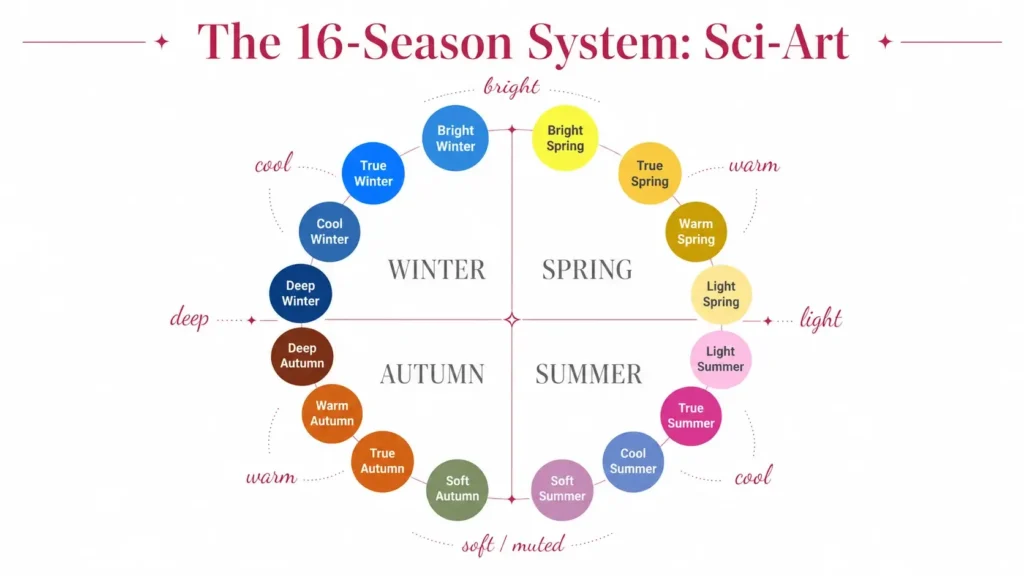
It was developed by Kathryn Kalisz, and it separates each season into four distinct categories: true, warm, light, and clear. Here’s a quick breakdown:
- Spring: True, Warm, Light, and Clear
- Autumn: True, Warm, Deep, and Soft
- Winter: True, Cool, Deep, and Clear
- Summer: True, Cool, Soft, and Light
2. 4×4 Color System
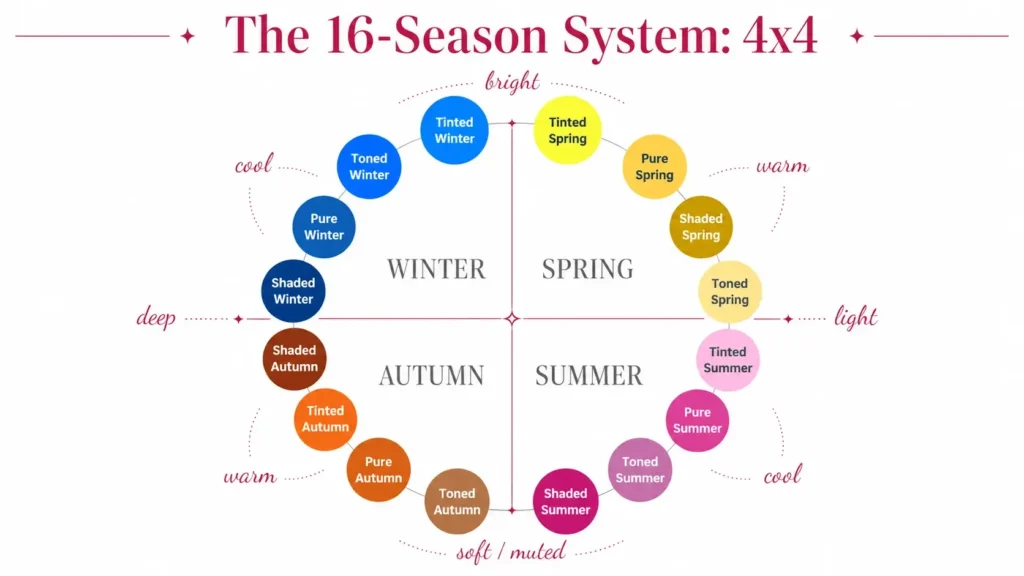
The 4×4 color system divides the seasons into four quadrants, winter, summer, spring, and autumn. Each contains four sub-seasons, based on color attributes: pure, tone, tint, and shade. Here’s how it looks:
- Winter: Pure Winter, Toned Winter, Tinted Winter, Shaded Winter
- Autumn: Pure Autumn, Toned Autumn, Tinted Autumn, Shaded Autumn
- Spring: Pure Spring, Toned Spring, Tinted Spring, Shaded Spring
- Summer: Pure Summer, Toned Summer, Tinted Summer, Shaded Summer
3. Tonal Color Analysis
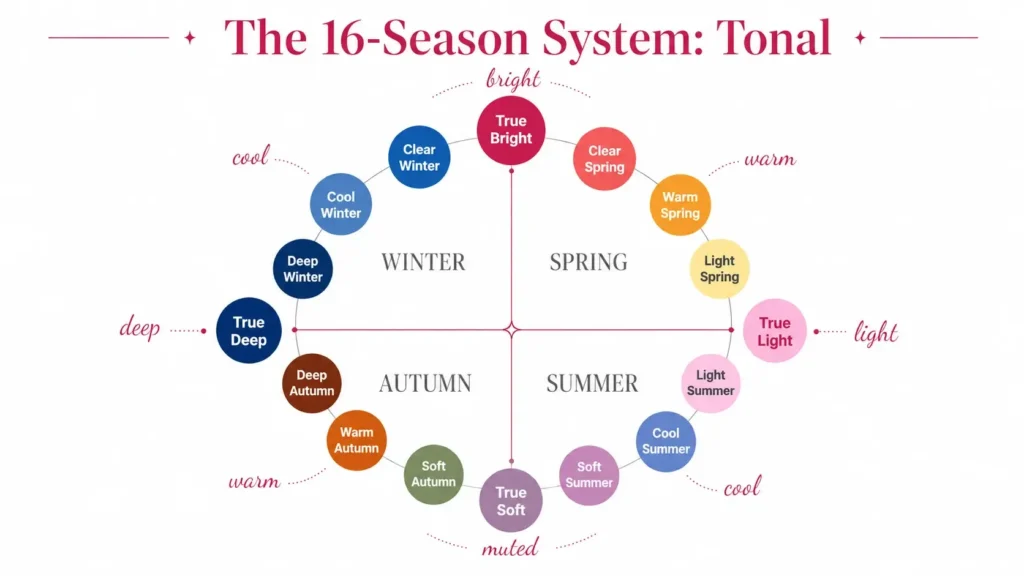
The tonal color analysis system adds four additional seasons beyond the traditional 12. It accounts for people whose features are more neutral and less strongly warm or cool. There are categories like “True Soft” for individuals who suit colors from both Soft Summer and Soft Autumn. The breakdown includes:
- Winter: True/Cool Winter, Clear Winter, Deep Winter
- Autumn: True/Warm Autumn, Deep Autumn, Soft Autumn
- Spring: True/Warm Spring, Light Spring, Clear Spring
- Summer: True/Cool Summer, Light Summer, Soft Summer
- Tonal: True Soft (between Soft Summer and Soft Autumn), True Light (between Light Spring and Light Summer), True Bright (between Clear Winter and Clear Spring), True Deep (between Deep Winter and Deep Autumn)
4. Custom Systems
Some 16-season variations explore the idea of people falling “between” seasons due to their cool or warm characteristics. For instance, a YouTube series by Style Me Jenn introduces variations like:
- Warm Seasons: Soft Spring and Light Autumn (for those between Spring and Autumn)
- Cool Seasons: Deep Summer and Soft Winter (for those between Summer and Winter)
5. House of Color
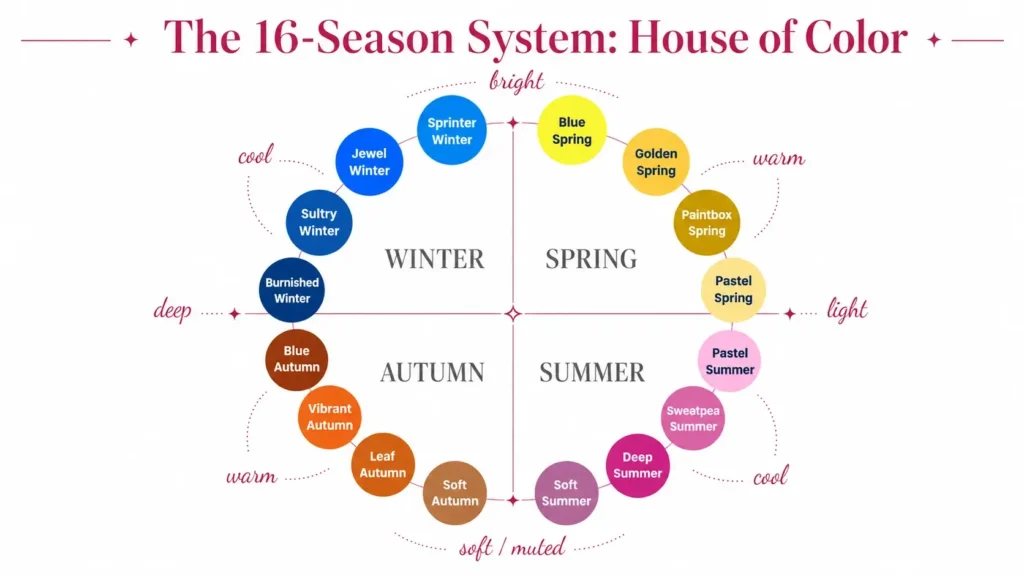
The House of Color system uses unique names for seasons, which are different from other 16-season methods. Here’s how they categorize each season:
- Winter: Jewel (True), Burnished (Deep), Sprinter (Clear), Sultry (Cool)
- Summer: Sweetpea (True), Pastel (Light), Deep and Soft
- Autumn: Leaf (True), Soft, Blue (Deep), Vibrant (Warm)
- Spring: Golden (True), Pastel (Light), Blue (Clear), Paintbox
The Benefit of the 16-Seasons
It caters to a wide diversity of people. If you fit into the more traditional 12 seasons or one of the 16, the systems help refine your choices. You can make your wardrobe and style feel more aligned with your natural beauty.
The Complexity
The biggest issue with the 16-season systems is that there’s no universal standard. There are multiple systems and interpretations. It can be hard to know which one applies to you, especially when trying to do color analysis on your own.
If you’ve been typed into one of the lesser-known seasons, it might be challenging to find your palette or shopping suggestions.
Summing Up
The 16-season color analysis system helps you find the colors if the traditional 12-seasons don’t cater you. You don’t need to trends or fit into a mold.
Understand your natural coloring and select colors that highlight your best features. Build a wardrobe that makes you feel confident and comfortable.
So, take your time, experiment with your colors, and embrace the process of discovering your true palette. It’s a fun journey that’s totally worth the effort!