

Deep Winter is dark, strong, and cool, but your wardrobe does not have to be black from top to bottom.
Black is useful. So are charcoal and navy. But the palette gets much more interesting once you add burgundy, cranberry, pine, deep teal, emerald, royal blue, aubergine, raspberry, and icy accents.Deep Winter
The key is depth.
Deep Winter is the darkest Winter subtype. It sits next to Deep Autumn in the 12-season system, so it shares Autumn’s ability to handle rich, substantial color while keeping a stronger Winter direction.
That means your best colors are usually deep first, then cool or cool-neutral, with enough clarity that they do not look faded or dusty.
Table of Contents
Start with depth. Keep enough Winter clarity. Then see how far toward warmth your individual coloring can go.
This page will show you how to select Deep Winter colors by value, chroma, temperature, contrast, clothing category, makeup, hair, metals, prints, and wardrobe combinations.
Let’s start!deep autumn.
Key Takeaways
- Depth is the main Deep Winter trait. Medium-deep to very dark colors usually work best.
- Cool or cool-neutral shades are the safest choice, but some Deep Winters can also handle slightly warmer colors from Deep Autumn.
- Best colors include burgundy, cranberry, raspberry, aubergine, pine, emerald, deep teal, royal blue, charcoal, navy, and black.
- Light colors should stay crisp or icy, such as pure white, icy pink, icy grey, and icy violet.
- Avoid colors that are too pale, dusty, warm, or muted, especially peach, camel, mustard, golden beige, and faded sage.
- Charcoal, navy, and aubergine are great alternatives to black when you want more variety.
- Silver, white gold, platinum, pewter, and gunmetal are easy metal choices, while some neutral-cool Deep Winters can also wear gold.
- Foundation should match your real skin tone, not your seasonal label.
- Use color comparisons instead of relying on one feature such as dark hair, olive skin, eye color, or the vein test.
- The easiest rule to remember is: choose depth first, then check temperature, chroma, and contrast.
Deep Winter at a Glance
| Color Quality | Deep Winter Direction |
|---|---|
| Main characteristic | Deep |
| Temperature | Usually cool to cool-neutral |
| Value | Medium-deep to very deep |
| Chroma | Medium-high to high |
| Contrast | Usually supports medium-high to high contrast |
| Best Colors | Cool-neutral Rich Shades and Jewel Tones |
| Strongest neutrals | Black, charcoal, navy, pewter, black-brown |
| Strongest colors | Burgundy, cranberry, pine, teal, emerald, aubergine, royal blue |
| Best light accents | Pure white, icy pink, icy grey, icy violet |
| Neighboring seasons | Deep Autumn and True/Cool Winter |
| Color Essence | Brilliant and intense |
In established color terminology, hue, value, and chroma describe different properties of a color. Value tells you how light or dark it is, while chroma describes color strength or saturation. That distinction is especially useful for Deep Winter because a color can be cool but still be too pale or too muted.
What Is Deep Winter?
Deep Winter, sometimes called Dark Winter, is a depth-dominant Winter subtype in a 12-season color system.
Its first priority is depth.
Its second major direction is Winter coolness and clarity.
That is why Deep Winter can often wear much darker colors than Light, Soft, or even some True/Cool seasonal types without the color becoming visually overwhelming.
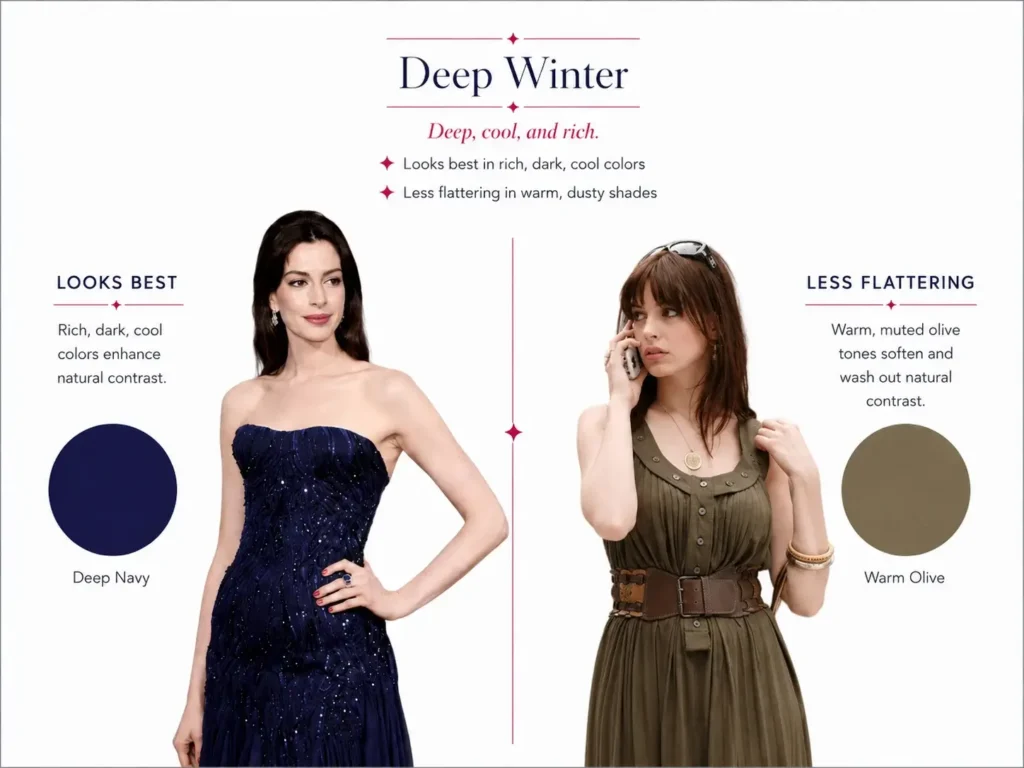
The traditional way calls Deep Winter “deep and cool” and gives it rich primaries, dark neutrals, and strong color combinations. Black, charcoal, navy, true red, pine, hot pink, turquoise, and other substantial colors appear throughout its recommendations.
A newer way to think about the system is more individual. Instead of assuming everyone assigned Deep Winter has exactly the same coloring, you can look separately at:
- Undertone
- Skin depth
- Complexion chroma
- Eye chroma
- Hair level
- Hair warmth
- Overall contrast
That explains why two Deep Winters may share a season but prefer somewhat different versions of brown, white, red, gold, or pink.
Deep Winter Season Characteristics
Deep Winter tends to have a sense of visual weight.
That does not mean everyone has black hair or very dark skin. It means deeper, stronger colors usually relate to the person’s coloring better than pale, powdery, or washed shades do.
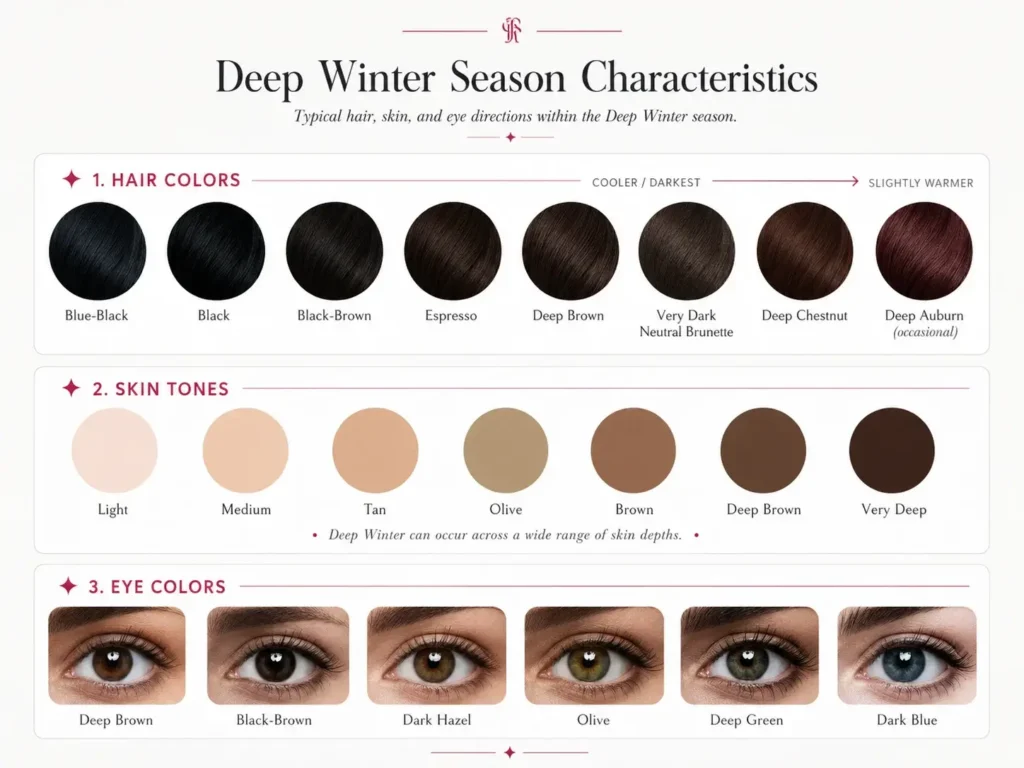
1. Skin
Deep Winter can occur across a wide range of skin depths.
Skin may appear:
- Light
- Medium
- Tan
- Olive
- Brown
- Deep brown
- Very deep
The traditional Deep Winter description explicitly includes cool beige, olive, cool brown, and black skin.
This is worth stressing because Deep Winter is often shown online using only one look: very fair skin with almost-black hair.
That is only one possible expression.
2. Hair
Common natural hair directions include:
- Deep brown
- Espresso
- Black-brown
- Black
- Very dark neutral brunette
- Blue-black
- Deep chestnut
- Occasionally deep auburn
The main pattern is usually depth rather than one exact undertone.
3. Eyes
Eyes may include:
- Deep brown
- Black-brown
- Dark hazel
- Olive
- Deep green
- Dark blue
Again, no eye color proves a season.
Deep brown eyes occur in several seasonal groups. So do hazel and green eyes.
4. Overall Effect
What matters is how everything works together.
You may notice that:
- Dark colors do not automatically overwhelm you.
- Rich colors often work better than faded ones.
- Medium-deep and dark colors form an easy base.
- Very dusty shades can look separate from your coloring.
- Light colors usually work better when they are crisp or icy rather than chalky.
- You can often support more contrast than Soft Autumn or Soft Summer.
Deep Winter Color Dimensions
Understanding the dimensions is much more useful than memorizing 40 color names.
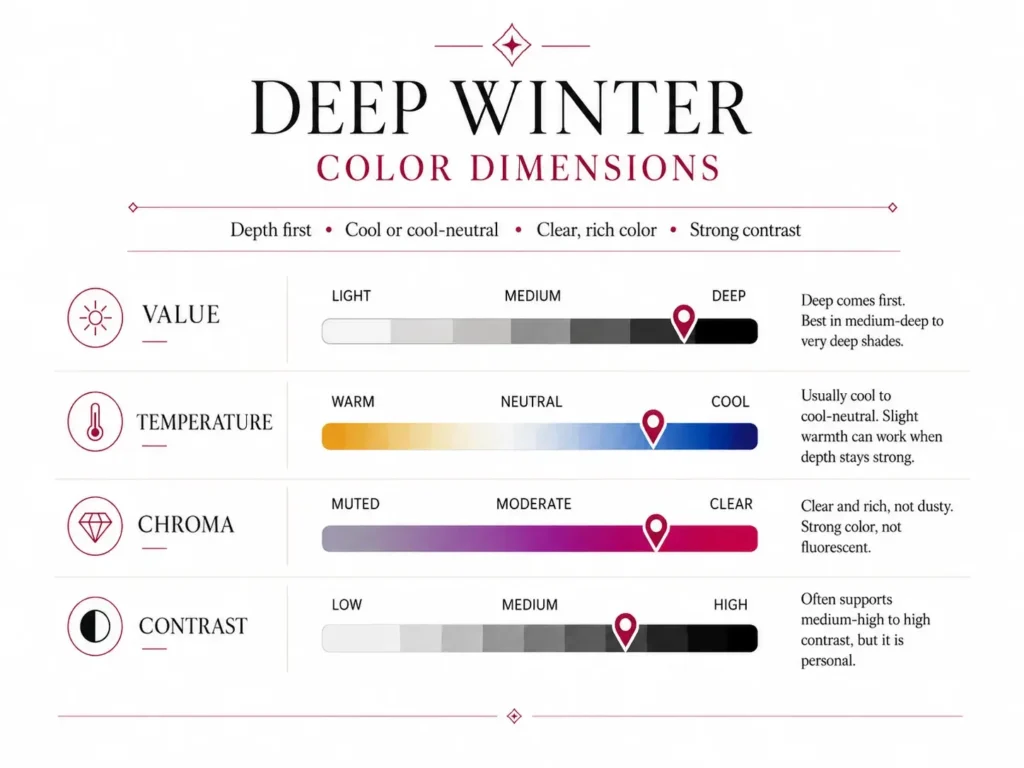
1. Value: Deep Comes First
Value means lightness or darkness. In the Munsell system, it runs from black at one end toward white at the other.
For Deep Winter, the strongest zone is generally medium-deep through very deep.
Like:
- Charcoal
- Deep navy
- Burgundy
- Aubergine
- Black-brown
- Pine
- Ink blue
- Deep teal
- Black
This is why a cool pastel and a deep cool color can produce very different results even though both technically have a cool undertone.
The deeper shade repeats the season’s main characteristic.
Does That Mean Light Colors Are Bad?
No. Deep Winter needs light colors too.
The difference is that the strongest lights tend to be clean, icy, or crisp rather than soft, dusty, or beige-heavy.
Pure white with navy creates clear separation.
Icy pink with charcoal does the same.
A muted peach-beige may be light too, but it also adds warmth and softness, taking the color farther from the core Deep Winter direction.
2. Temperature: Cool, but Not Necessarily Extreme
Deep Winter belongs to Winter, so the safest part of the palette leans cool or cool-neutral.
For example:
- Cranberry over brick-orange
- Raspberry over salmon
- Pine over yellow-green
- Blue-red over orange-red
- Charcoal over camel
- Pure white over yellow cream
But this is where Deep Winter differs from Cool Winter.
Deep Winter touches Deep Autumn.
The older Deep Winter palette includes warmer crossover shades such as tomato red, rust, olive, mahogany, black-brown, and gold. Cool Winter, by contrast, is described as needing a more consistently cool palette and moving away from some of those warmer Deep Winter shades.
So some Deep Winters are noticeably neutral-cool rather than strongly cool.
If that is you, temperature may be more flexible than value.
A deep slightly warm color may work better than a very cool color that is far too pale.
3. Chroma: Strong, but Not Neon
Chroma describes the strength or brilliance of color.
Deep Winter generally needs enough chroma that colors do not look faded. It is usually better in:
- Ruby instead of faded rose
- Emerald instead of dusty sage
- Raspberry instead of muted mauve
- Royal blue instead of washed denim
- Deep teal instead of grey-green
The palette can contain some softened neutrals such as pewter, taupe, stone, and medium grey, but its main color direction should not become chalky or heavily greyed.
4. Contrast: Strong, but Personal
Deep Winter generally supports stronger contrast. That may mean:
- Light against dark
- Bright against deep
- Two dark colors with a clear difference in hue
- A crisp accent against a dark neutral
But personal contrast still varies. A person with light skin and almost-black hair may naturally have a large light-dark difference.
A person with deep skin, dark eyes, and dark hair may have less value contrast between those features, even though their overall coloring is very deep.
That is why “every Deep Winter must wear black and white” is too simple.
Some dark-skinned Deep Winters can lose definition when wearing too much black or black-brown close to the face. Stronger color contrast may work better.
The Deep Winter Core Color Palette
A Deep Winter palette gives you more than black and jewel tones. It should contain light, medium, dark, neutral, and crossover options.
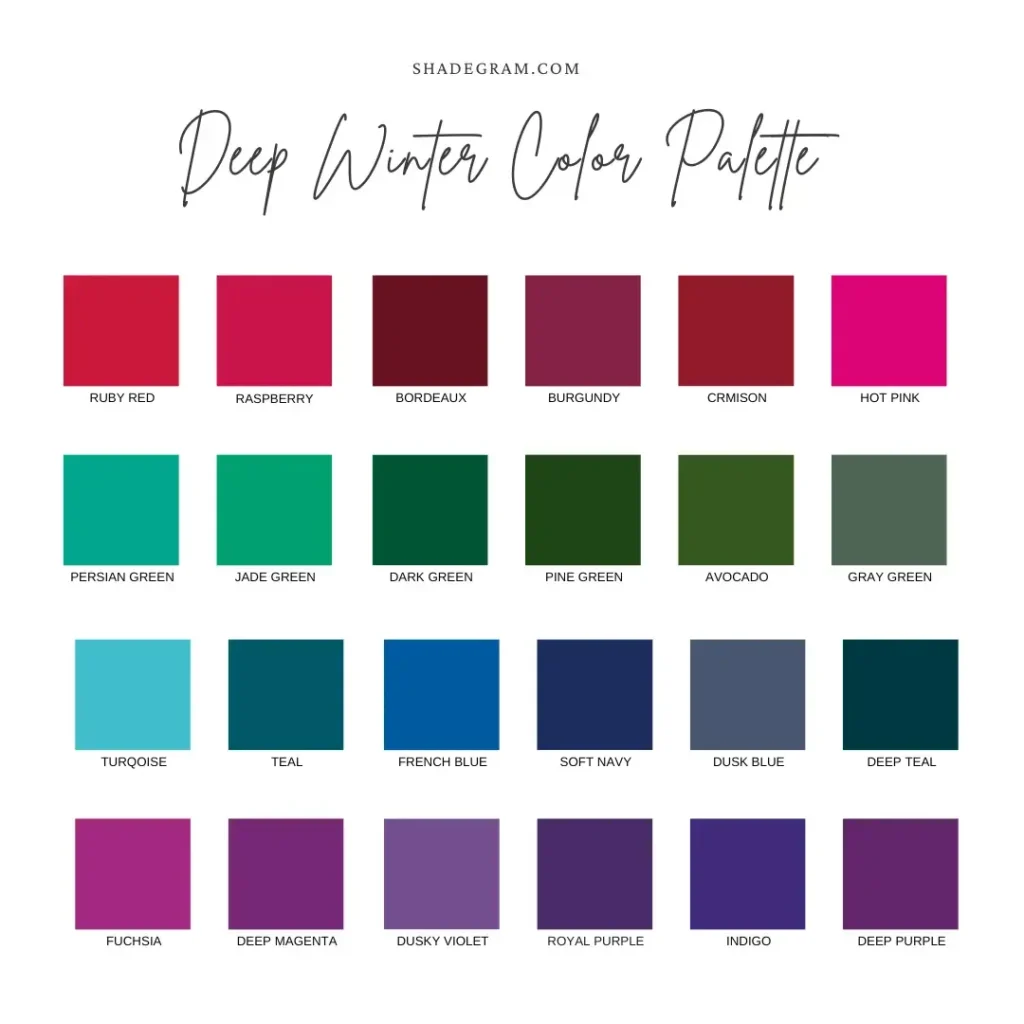
Best Deep Winter Reds
Red is one of the strongest color families.
Try:
- True red
- Blue-red
- Cranberry
- Burgundy
- Deep cherry
- Ruby
- Raspberry red
- Wine red
- Brown-burgundy
Some Deep Winters can also wear:
- Deep tomato red
- Deep red-rust
The key is keeping enough depth.
A warm coral-red can become too light and orange.
A dark tomato red may still work because it retains more weight and sits close to Deep Autumn.
Best Deep Winter Pinks
Look for pinks with strength.
Strong options include:
- Raspberry
- Magenta
- Fuchsia
- Hot pink
- Deep rose
- Berry pink
- Cranberry pink
- Icy pink
If an electric fuchsia seems louder than you are, move deeper toward raspberry or berry.
Best Deep Winter Purples
Purple is one of the easiest Deep Winter families.
Try:
- Aubergine
- Blackberry
- Deep plum
- Royal purple
- Blue-violet
- Amethyst
- Deep periwinkle
- Cool wine-purple
Aubergine is especially useful because it can function almost like a neutral.
Use it for dresses, coats, knitwear, eyeliner, bags, and shoes.
Best Deep Winter Blues
You have plenty of options.
Try:
- Navy
- Ink navy
- True blue
- Royal blue
- Sapphire
- Chinese blue
- Deep periwinkle
- Cobalt, if it is not too electric
- Blue-black
The main colors to watch are faded or greyed blues.
Washed denim and dusty blue may lack enough depth or clarity.
Best Deep Winter Greens
Strong options include:
- Pine
- Forest green
- Emerald
- True green
- Deep teal
- Clear teal
- Emerald turquoise
- Blue-green
Can Deep Winter Wear Olive?
Yes, some can. Olive appears directly in the older Deep Winter palette.
But not every olive works. Compare:
Better candidate: deep, substantial olive with limited yellow
Hard: dusty khaki olive
Harder: pale yellow-olive
If olive consistently makes the face look dull, stay with pine, forest, teal, or emerald.
Best Deep Winter Yellows
Yellow is smaller in the Deep Winter wardrobe, but it is not absent.
Try:
- Lemon yellow
- Icy yellow
- Clear cool yellow
Use yellow when you want a bright contrast accent rather than forcing it to become a major neutral.
Mustard and ochre are harder because they combine warmth with mutedness.
Can Deep Winter Wear Orange?
Orange is one of the harder color families.
Pure orange, golden orange, peach, and pumpkin can move too warm.
If you love orange, move toward red:
- Tomato red
- Deep red-orange
- Deep rust
- Burnt red
It keeps some of the same energy without moving as far from the Deep Winter range.
Best Light Colors for Deep Winter
Your light colors should usually stay clean.
Good choices include:
- Pure white
- Soft white
- Icy grey
- Icy pink
- Icy violet
- Icy green
- Mint
- Icy yellow
These lighter shades appear in the traditional Deep Winter palette alongside the much darker neutrals.
Best Way to Use Them
Pair a light with depth:
- Icy pink + charcoal
- Pure white + navy
- Mint + black
- Icy violet + aubergine
- Icy grey + pine
- Icy yellow + deep navy
You do not need to use icy colors only as tiny accents, but pairing them with deeper colors usually preserves more of the Deep Winter character.
Best Medium Colors for Deep Winter
The medium range keeps your wardrobe from becoming too dark.
Try:
- True red
- Raspberry
- Magenta
- Fuchsia
- Turquoise
- Emerald
- True blue
- Royal blue
- Purple
- Deep periwinkle
- Clear teal
These are excellent for tops because they bring color close to the face without relying on black.
Best Dark Colors for Deep Winter
Try:
- Black
- Charcoal
- Deep navy
- Aubergine
- Black-brown
- Espresso
- Burgundy
- Brown-burgundy
- Pine
- Deep forest
- Deep teal
- Deep plum
A good Deep Winter wardrobe usually contains more than one dark neutral.
If everything is black, you lose a lot of the palette.
Best Neutrals for Deep Winter
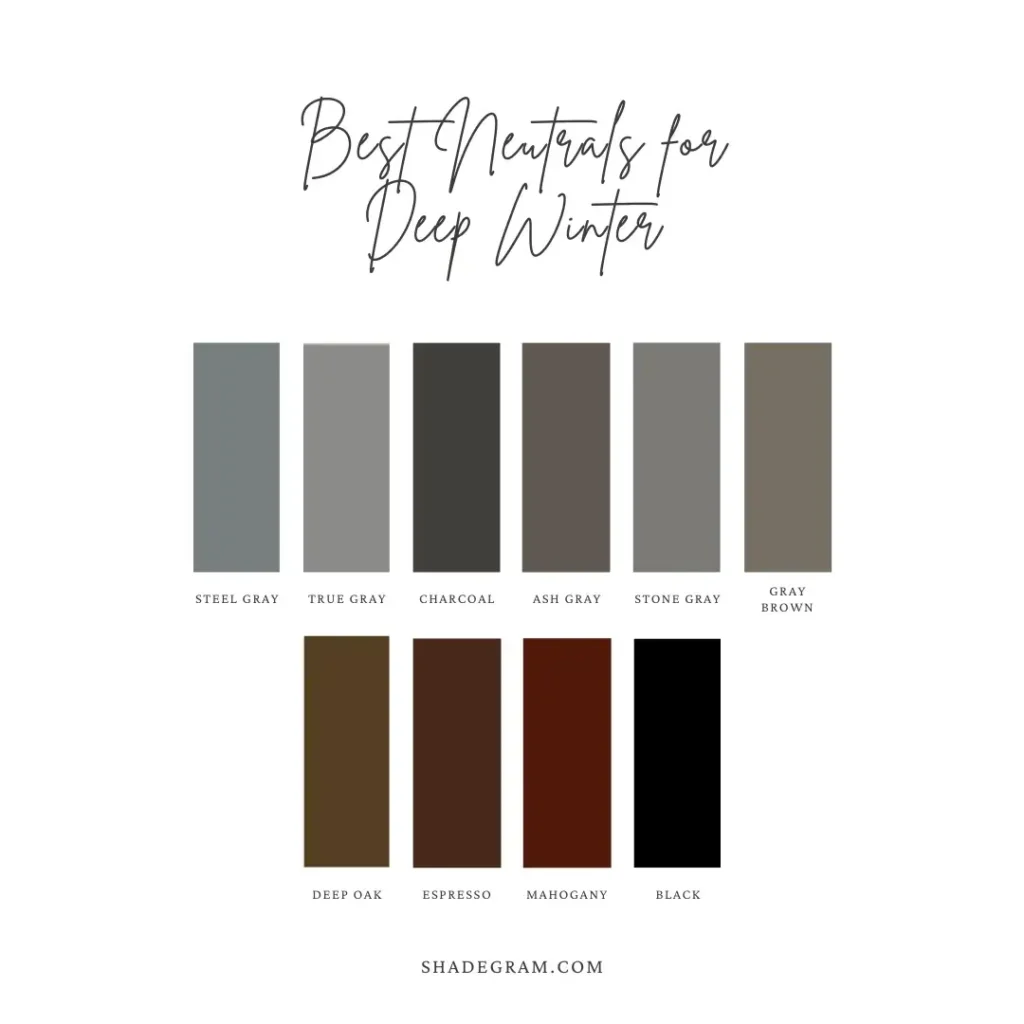
Start with:
- Black
- Charcoal
- Navy
- Pewter
- Medium grey
- Black-brown
- Espresso
- Taupe
- Stone
- Pure white
- Soft white
You do not need to buy all of them.
Choose a small neutral system.
For example:
Black + charcoal + white
or:
Navy + pewter + soft white
or:
Black-brown + charcoal + pure white
Then add color.
Best White for Deep Winter
The classic choice is pure white.
It gives you the crisp Winter contrast that ivory cannot.
Pure white is also used directly in traditional Deep Autumn vs Deep Winter draping, where Deep Autumn is compared in ivory and Deep Winter in pure white.
But do not turn this into another absolute.
Soft white also appears in the traditional Deep Winter palette.
Use:
Pure white for stronger contrast.
Soft white when optic white feels harder than you want.
Be more cautious with:
- Yellow cream
- Buttermilk
- Warm ivory
especially right beside the face.
Best Brown for Deep Winter
Start at the deepest end:
- Black-brown
- Espresso
- Bitter chocolate
- Dark neutral brown
- Brown-burgundy
- Very deep mahogany
Black-brown, brown-burgundy, and mahogany all appear in the older Deep Winter range.
The harder browns tend to be lighter and more golden:
- Camel
- Honey
- Caramel
- Tan
- Toffee
- Golden brown
For leather, espresso is usually an easier place to start than cognac.
Best Gray for Deep Winter
Gray is one of your best neutral families.
Charcoal
Your strongest all-purpose grey.
Use it for:
- Coats
- Blazers
- Trousers
- Knits
- Dresses
Pewter
A slightly softer option.
Great for:
- Knitwear
- Shoes
- Bags
- Metallic details
- Eyewear
Medium Grey
Useful when black and charcoal feel too dark for daytime.
Pair it with:
- Cranberry
- Royal blue
- Raspberry
- Navy
- Pine
Icy Grey
Treat it like a light color.
Pair it with charcoal, burgundy, navy, or aubergine.
Best Navy for Deep Winter
Look for navy that still reads clean. Good choices include:
- Ink navy
- Blue-black
- Deep cool navy
- Clear dark navy
Avoid navy that looks:
- Dusty
- Green-brown
- Faded
- Heavily greyed
Navy works especially well if you want an alternative to black for workwear.
Try:
- Navy + pure white
- Navy + cranberry
- Navy + raspberry
- Navy + emerald
- Navy + icy pink
- Navy + silver
Best Black Alternative
Try charcoal. It keeps the depth but removes some of black’s hardness.
Other good black substitutes are:
- Ink navy
- Aubergine
- Black-brown
- Deep pine
- Deep teal
Match the alternative to the item.
For a blazer, charcoal is easy.
For a dress, aubergine can look richer.
For trousers, navy or black-brown works well.
For knitwear, deep teal adds color without losing depth.
Best Denim for Deep Winter
Denim is easy when you keep it clean and deep.
Strong washes include:
- Dark indigo
- Ink blue
- Clean deep navy denim
- Black denim
- Charcoal denim
Medium blue can work too if the wash remains clear rather than dusty or yellowed.
Be cautious with:
- Heavy golden fading
- Orange-brown whiskering
- Warm stonewash
- Very pale washed denim near the face
For jeans, color analysis matters less because they sit away from the face, so wear the wash you like. If you are choosing a denim jacket or shirt, the palette matters more.
Best Leather Colors
Deep Winter has more leather options than black.
Try:
- Black
- Espresso
- Black-brown
- Burgundy
- Oxblood
- Deep navy
- Aubergine
- Charcoal
For jackets close to the face, your stronger palette colors matter more.
For shoes and bags, you can be much more flexible because the color sits farther away from your complexion. Colors away from the face have less direct effect on facial harmony.
Metals for Deep Winter
Cool metals are the safest starting point:
- Silver
- Platinum
- White gold
- Stainless steel
- Pewter
- Gunmetal
- Oxidized silver
Can Deep Winter Wear Gold?
Yes, because the season sits beside Deep Autumn. But if you are strongly cool, silver may look much easier. If you are more neutral-cool, you may find that both work.
Try:
- Neutral yellow gold
- Deeper gold
- Gold with ruby, navy, emerald, black, or purple
- Mixed metals
Harder options may include very orange gold, copper, or strong yellow brass.
Do not replace your jewelry collection because one chart says you are only allowed silver.
Test the actual metal.
Deep Winter Jewelry
Season tells you more about jewelry color than jewelry shape.
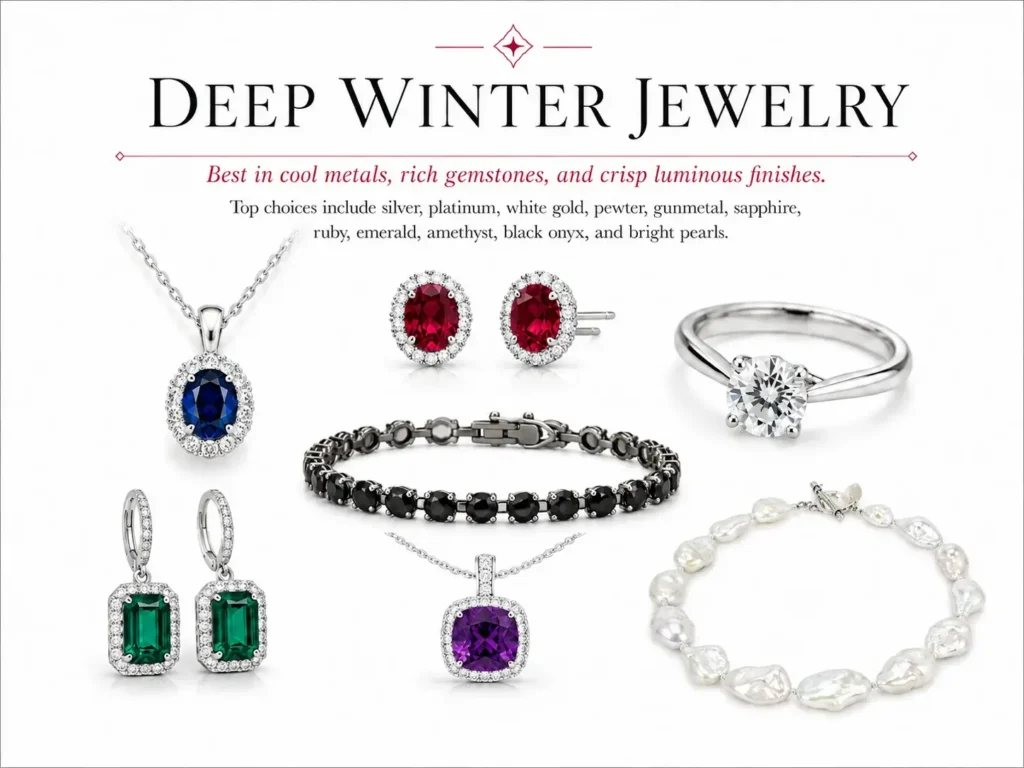
Choose the shape and scale according to your:
- Face
- Personal style
- Outfit
- Preference
For color, try:
Gemstones
- Sapphire
- Ruby
- Emerald
- Amethyst
- Black onyx
- Hematite
- Diamond
- Dark garnet
- Deep blue stones
- Cool green stones
- Dark purple stones
Pearls
Try:
- Bright white
- Silver-grey
- Black pearls
Cream and golden pearls can be warmer, so compare them before buying.
Good Jewelry Combinations
- Silver + sapphire
- White gold + ruby
- Gunmetal + black onyx
- Silver + amethyst
- Platinum + diamond
- Gold + deep emerald, for an Autumn-leaning Deep Winter
Eyewear Colors
Glasses sit directly on your face, so color matters more here than it does for shoes or a handbag.
Good frame colors include:
- Black
- Charcoal
- Pewter
- Gunmetal
- Deep navy
- Burgundy
- Aubergine
- Deep teal
- Silver
- Black-brown
Tortoiseshell can work if it is dark and relatively neutral.
Warm amber tortoiseshell may pull too golden.
The frame’s shape and scale should still fit your face and style. Your season should not dictate if you wear round, square, thin, or bold frames.
Deep Winter Makeup
Makeup should repeat your color logic without turning the face into a palette chart.
The most important correction is this:
Your foundation should match your actual skin.
Do not choose a pink foundation just because Winter is described as cool.
Do not avoid a neutral or olive foundation because a seasonal chart says “cool.”
Evaluate foundation direction separately from the season label because skin tone and surface coloring vary considerably within a season.
Foundation and Concealer
Match:
- Undertone
- Depth
- Skin itself
not your seasonal name.
If your skin is olive, use an olive-compatible base.
If it is neutral-cool, choose that.
If your skin requires some yellow in foundation to match correctly, do not force a pink formula on it.
The foundation should disappear into the skin.
Best Deep Winter Lip Colors
This is one of your strongest makeup categories.
Try:
- Blue-red
- True red
- Cranberry
- Berry
- Burgundy
- Wine
- Plum
- Raspberry
- Deep rose
- Fuchsia
- Blackberry
Everyday Lip
Try:
- Raspberry
- Berry stain
- Deep rose
- Rose-plum
- Neutral-cool red
Stronger Lip
Try:
- Burgundy
- Blue-red
- Deep plum
- Cranberry
- Blackberry
If the color is so bright that you notice the lipstick long before your face, go deeper rather than automatically going softer.
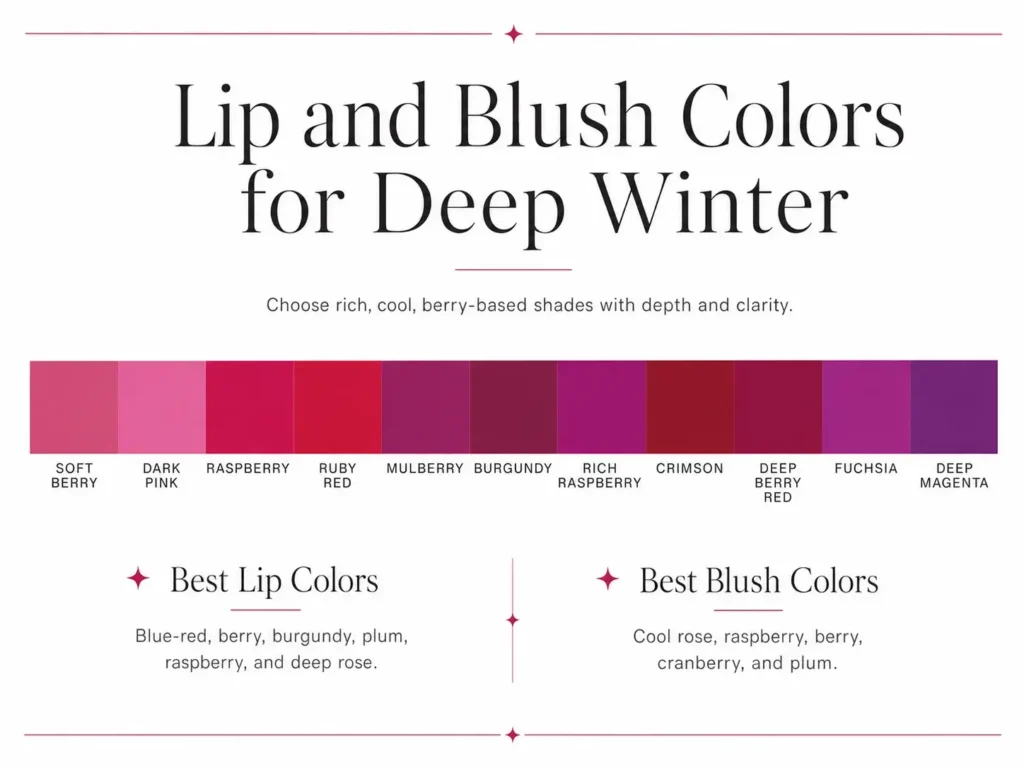
Best Blush
Good directions include:
- Cool rose
- Raspberry
- Berry
- Cranberry
- Plum
- Deep rose
Current Winter makeup guidance also focuses on rose, raspberry, cool pink, and cranberry.
Use the amount that fits your own contrast.
A Deep Winter with very deep skin may need more pigment than a Deep Winter with light skin.
The seasonal name does not tell you how much product to apply.
Eyeshadow
Strong neutrals include:
- Charcoal
- Slate
- Pewter
- Cool taupe
- Black-brown
- Navy
Color options include:
- Aubergine
- Plum
- Purple
- Spruce
- Pine
- Emerald
- Teal
- Sapphire
Light accents can include:
- Icy grey
- Icy pink
- Silver
- Mint
- Cool champagne
The traditional Deep Winter makeup list is broader than many modern guides and includes black-brown, grey, purple, spruce, olive, aubergine, mint, champagne, and other options.
Eyeliner and Mascara
Good eyeliner colors:
- Black
- Charcoal
- Navy
- Black-brown
- Aubergine
- Deep plum
Black mascara is an easy choice because Deep Winter generally handles strong definition well.
Bronzer and Contour
You do not have to ban bronzer.
The issue is using a bronzer that turns obviously orange against your skin.
If your skin naturally tans or bronzes, choose a shade that actually matches that effect.
For contour, look for a believable shadow color for your complexion rather than a generic grey-brown labeled “cool contour.”
Highlighter
Good directions may include:
- Neutral pearl
- Icy pearl
- Cool champagne
- Soft silver sheen
The exact shade should still relate to your skin depth.
A white-silver highlighter that works on very light skin can look ashy on deeper skin.
Makeup Contrast
Deep Winter often supports a stronger lip or stronger eye more easily than muted seasons.
But you do not need full dramatic makeup every day.
For a softer day:
- Defined lashes
- Cool rose blush
- Raspberry lip
For evening:
- Charcoal or plum eye
- Black liner
- Berry, wine, or blue-red lip
The important point is that “soft makeup” does not have to mean warm beige makeup.
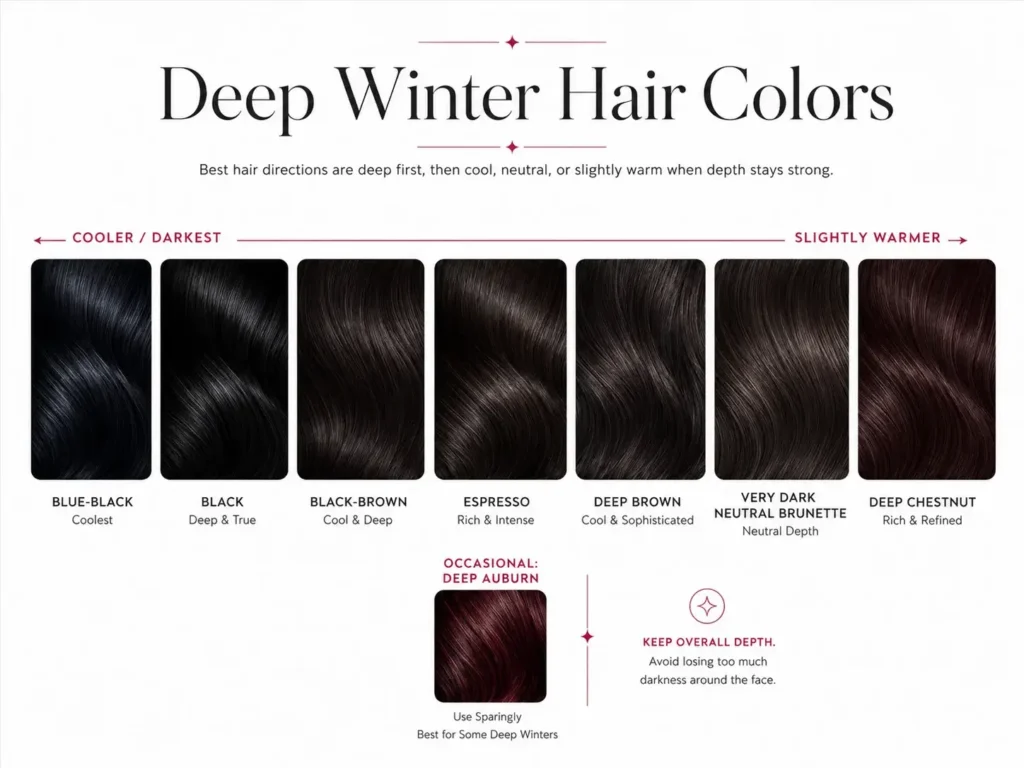
Deep Winter Hair Colors
Hair has a large color impact because it surrounds your face every day.
Your strongest hair direction generally preserves depth.
Good options include:
- Deep neutral brown
- Deep ash brown
- Espresso
- Cool dark brunette
- Soft black
- Blue-black, when it works with your natural coloring
Try deep ash or neutral brunette shades and burgundy rather than auburn when adding red.
Can Deep Winter Get Highlights?
Yes, but keep the overall depth in mind.
Better directions include:
- Subtle ash-brown ribbons
- Neutral brunette dimension
- Very dark cool lowlights
- Deep burgundy accents
Harder options include:
- Honey
- Caramel
- Golden blonde
- Bright copper
- Strong warm balayage
Highlights are not a main issue. You should not loose too much depth or add obvious golden-orange warmth around the face.
Going Lighter
If you lighten your hair dramatically, you change one of the largest color areas around your face.
That can affect:
- Contrast
- Apparent depth
- How much dark clothing you want near your face
If you want lighter hair, test how far you can go while keeping enough connection to your natural coloring.
A light ash shade is not automatically right just because it is cool.
Value matters too.
Gray and Silver Hair
Deep Winter often has good options here.
Possible natural shades include:
- Steel grey
- Salt-and-pepper
- Silver
- White-grey
Do not assume grey hair means your entire season changes instantly.
But as hair lightens, your contrast pattern can change.
You may find yourself preferring slightly different combinations than you did with dark brunette hair.
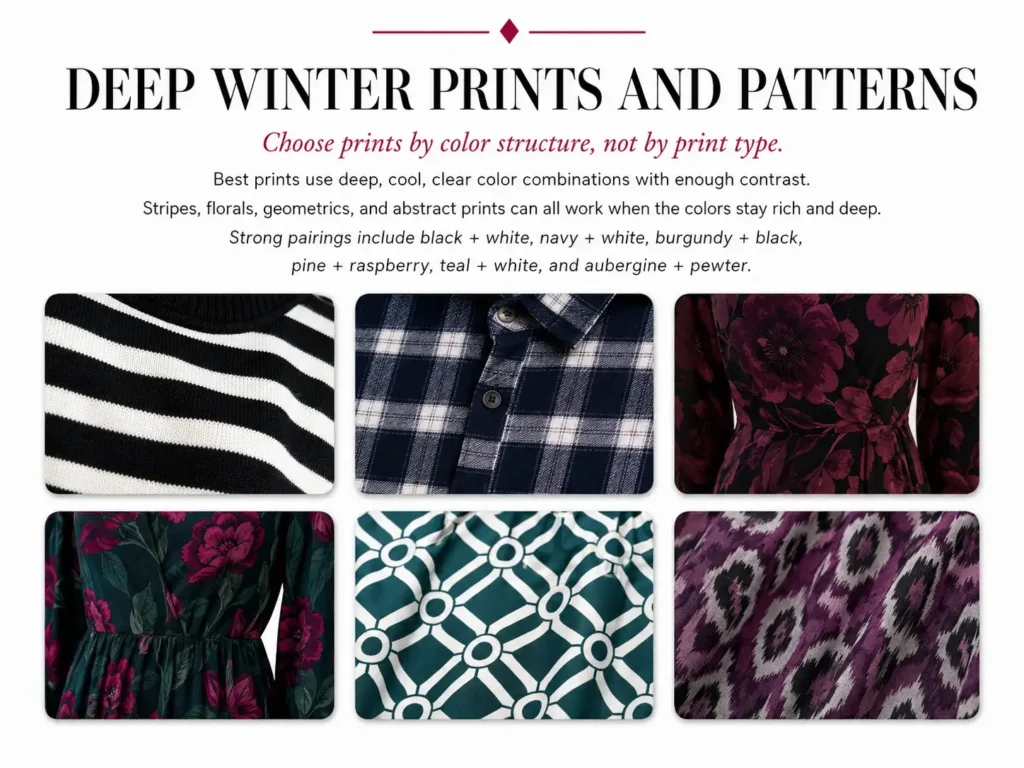
Prints and Patterns
Your season does not decide if you should wear florals, stripes, checks, geometric prints, abstract prints, or animal prints.
Those are style choices.
What the season can help with is the color structure inside the print.
Good combinations include:
- Black + white
- Navy + white
- Burgundy + black
- Charcoal + icy pink
- Pine + raspberry
- Royal blue + black
- Teal + white
- Aubergine + pewter
- Navy + cranberry
- Black-brown + turquoise
What Makes a Print Harder?
A print can become difficult if all of its colors are:
- Warm
- Dusty
- Light
- Similar in value
For example:
camel + peach + mustard + dusty sage
contains very little of the depth or Winter clarity that usually supports Deep Winter.
Does Deep Winter Need Large Prints?
No. Pattern scale is not determined by color season. A small black-and-white pattern can work. A large jewel floral can work.
Choose scale based on your own style and proportions.
Contrast Recommendations
Think about contrast in more than one way.
Light-Dark Contrast
Examples:
- Black + white
- Navy + icy pink
- Charcoal + icy grey
Color Contrast
Examples:
- Pine + raspberry
- Burgundy + turquoise
- Royal blue + white
Deep Tonal Contrast
You can also wear several deep colors without using a light one.
For example:
- Aubergine + burgundy
- Navy + royal blue
- Charcoal + black + pewter
- Pine + deep teal
This keeps depth while creating enough difference in hue or texture to stop the outfit from looking flat.
If You Have Deep Skin
Do not automatically assume that more darkness is always better.
Black next to deep skin and dark hair can sometimes create less contrast than a strong jewel color.
Try:
- True red
- Raspberry
- Royal blue
- Turquoise
- Emerald
- Pure white
near the face and compare them with all-black.
If You Have Light Skin
You may already have strong value contrast if your hair is very dark.
That can make combinations such as:
- Black + white
- Navy + icy pink
- Charcoal + pure white
feel very natural.
But you still do not need high contrast every day.
Aubergine with burgundy can give you a quieter Deep Winter outfit without leaving the palette.
Deep Winter Outfit Formulas
You do not need complicated outfits, but need combinations you can repeat.
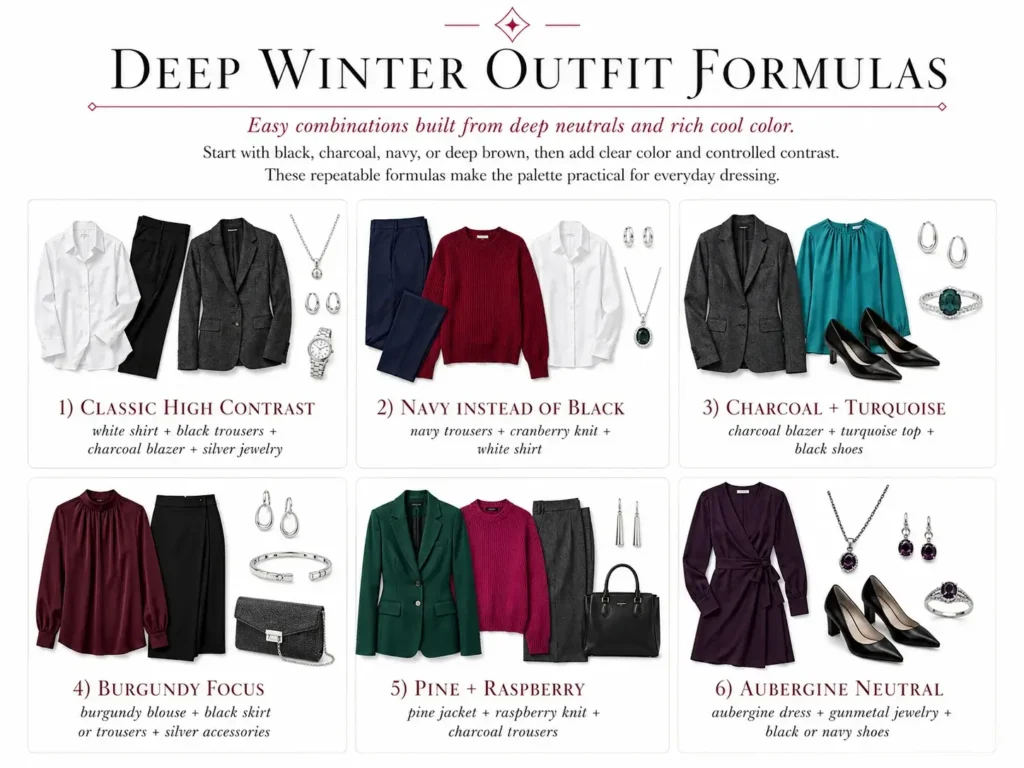
1. Classic High Contrast
Pure white shirt
Black trousers
Charcoal blazer
Silver jewelry
2. Navy Instead of Black
Navy trousers
Cranberry knit
Pure white collar or shirt
Pewter earrings
3. Charcoal and Turquoise
Charcoal suit or jacket
Turquoise top
Black shoes
Charcoal with turquoise is directly recommended in the traditional Deep Winter wardrobe guidance.
4. Burgundy Focus
Burgundy blouse
Black skirt or trousers
Black or silver accessories
5. Pine and Raspberry
Pine jacket
Raspberry knit
Charcoal trousers
6. Aubergine Neutral
Aubergine dress
Gunmetal jewelry
Black or navy shoes
7. Deep Blue Tonal
Ink navy trousers
Royal blue top
Navy coat
Silver jewelry
8. Softer Deep Winter
Medium grey trousers
Deep rose top
Charcoal cardigan
Pewter accessories
9. Warm-Crossover Deep Winter
Deep olive jacket
Black top
Burgundy trousers or skirt
Gold or mixed-metal jewelry
Use this only if olive and gold genuinely work on you.
10. Casual Deep Winter
Dark indigo jeans
Pure white T-shirt
Black leather jacket
Berry lip
11. Evening
Aubergine, burgundy, true red, royal blue, or black dress
Silver or white-gold jewelry
Berry or blue-red lip
12. Black, Red, and White
Black jacket
True-red top
White detail
Black bottom
Deep Winter Capsule Wardrobe
A good capsule should give you enough depth without making everything look identical.
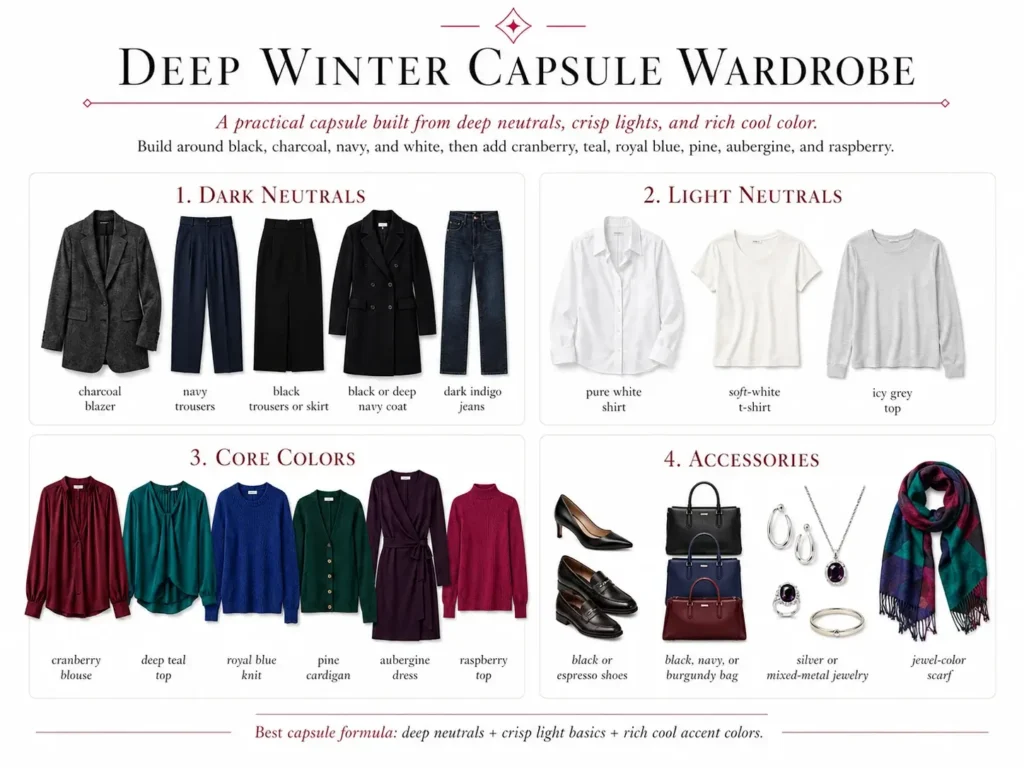
Dark Neutrals
- Charcoal blazer
- Navy trousers
- Black trousers or skirt
- Black or deep navy coat
- Dark indigo jeans
Light Neutrals
- Pure white shirt
- Soft-white T-shirt
- Icy grey top
Core Colors
- Cranberry blouse
- Deep teal top
- Royal blue knit
- Pine cardigan
- Aubergine dress
- Raspberry top
Accessories
- Black or espresso shoes
- Black, navy, or burgundy bag
- Silver or mixed-metal jewelry
- Jewel-color scarf
Why This Works
Your neutral base is:
black + charcoal + navy + white
Your core color group is:
cranberry + teal + royal blue + pine + aubergine + raspberry
Every core color can work with multiple neutrals.
That gives you far more combinations than buying unrelated “statement colors.”
A Simple Color Ratio for Your Wardrobe
You do not need a fixed mathematical ratio, but a practical setup is:
- Most large investment pieces in neutrals
- Several tops and knits in your strongest colors
- A smaller group of light accents
- A few crossover colors if they suit you personally
It makes coats, trousers, shoes, and jackets easier to mix while leaving enough room for color near the face.
Deep Winter in Spring and Summer
Deep Winter does not have to look heavy all year.
You do not need burgundy coats and black knitwear in July.
Use the lighter and clearer side of the palette.
Try:
- Pure white + turquoise
- White + royal blue
- Icy pink + navy
- Lemon yellow + charcoal
- Mint + black
- Raspberry + white
- Emerald + white
- True red + navy
- Deep teal + white
Use lighter fabrics if you want, but keep the color direction. The palette is about color, not season-of-the-year fabric rules.
Deep Winter in Fall and Winter
Cooler months make the dark side of the palette easy.
Try:
- Charcoal
- Black
- Navy
- Aubergine
- Burgundy
- Pine
- Espresso
- Deep teal
- Plum
Layer related deep colors rather than falling back on all-black every day.
For example:
navy coat + royal blue knit + charcoal trousers
or:
aubergine knit + burgundy scarf + black trousers
Formalwear and Occasion Colors
If you want something other than black, Deep Winter has strong formal options.
Try:
- True red
- Burgundy
- Aubergine
- Royal blue
- Deep emerald
- Sapphire
- Deep teal
- Cranberry
For bridal white, pure white is the classic Winter direction.
If pure optic white feels too sharp, compare it with soft white before moving all the way to warm ivory.
Colors That Can Be Difficult
The hardest shades usually move away from Deep Winter in more than one dimension.
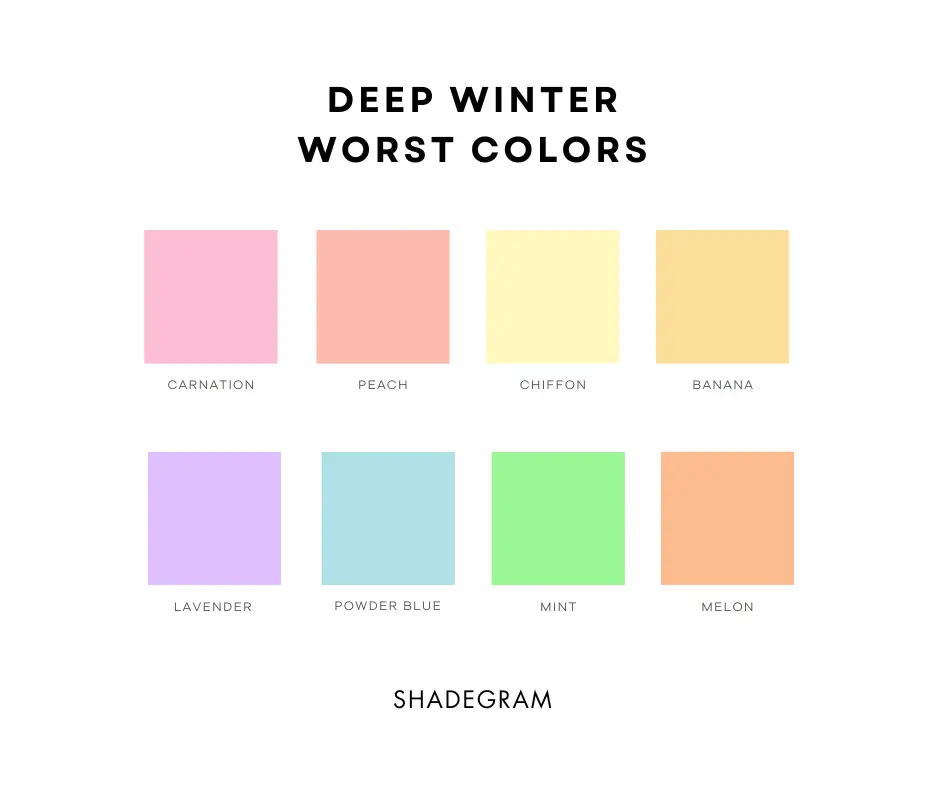
Light + Warm + Muted
Examples:
- Peach
- Warm beige
- Camel
- Apricot
- Soft coral
Warm + Muted
Examples:
- Mustard
- Ochre
- Dusty khaki
- Golden olive
Cool but Too Dusty
Examples:
- Dusty mauve
- Washed blue
- Grey-lavender with very low chroma
- Faded sage
A color can be cool and still be difficult.
Very Warm Orange
Examples:
- Tangerine
- Pumpkin
- Golden orange
These tend to sit far from Winter’s red-blue side.
Do Not Automatically Avoid Rust, Olive, Tomato Red, or Gold
These are the interesting Deep Winter exceptions.
They make more sense when you remember where Deep Winter sits. It touches Deep Autumn.
So the question is not:
“Is olive allowed?”
Ask:
“Which olive?”
Compare:
- pale yellow olive vs deep olive
- dusty khaki vs rich olive
The same goes for rust.
Bright orange-rust may be hard.
- Deep red-rust may work much better.
- Tomato red works best when it has enough depth.
- Gold works best when your own undertone can support some warmth.
That is exactly why individual color response matters more than copying a single chart. The personal-color approach treats each person’s undertone, chroma, depth, contrast, and “best and worst” versions of specific color families separately.
How to Modify Difficult Colors
You have three main controls:
- Temperature
- Value
- Chroma
Use them.
| If This Is Hard | Try This |
|---|---|
| Camel | Charcoal, taupe, black-brown |
| Warm cream | Pure white or soft white |
| Peach | Icy pink or raspberry |
| Coral | Cranberry or blue-red |
| Mustard | Lemon or icy yellow |
| Yellow olive | Pine or deeper olive |
| Pumpkin | Tomato red or deep rust |
| Caramel | Espresso |
| Golden beige | Stone or pewter |
| Dusty blue | True blue, royal blue, navy |
| Dusty mauve | Raspberry, plum, aubergine |
| Copper | Pewter, silver, gunmetal |
| Soft sage | Pine, teal, emerald |
What If You Love a Color That Is Not Deep Winter?
Wear it.
Just decide how much effect you want it to have.
Move It Away From Your Face
Use it for:
- Trousers
- Skirts
- Shoes
- Bags
- Belts
Color analysis matters most around the face.
Use Less of It
Try:
- Nail polish
- A print detail
- A bracelet
- A handbag
- A stripe
Put a Better Color Near Your Face
Love a camel coat?
Add:
- Burgundy scarf
- Navy turtleneck
- Black top
- Raspberry collar
Change the Version
Do not give up green because one olive was bad.
Do not give up pink because pale peach-pink was bad.
Find another version.
That is much more useful than maintaining a list of forbidden colors.
Deep Winter Sister Seasons
Deep Winter has two main neighbors.
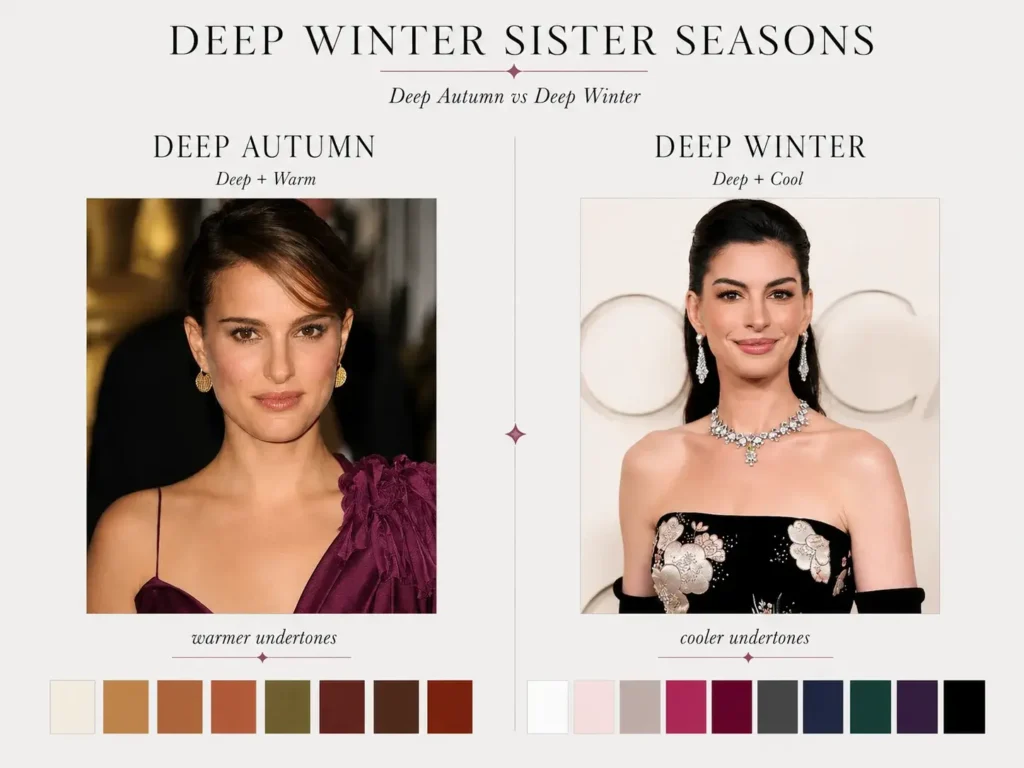
1. Deep Autumn
It is your warm-side sister. You share depth.
Common ground may include:
- Deep greens
- Dark reds
- Strong neutrals
- Dark browns
- Black
- Charcoal
- Emerald
- Royal blue
The split is temperature.
Deep Autumn moves more golden, brown, spicy, and earthy.
Deep Winter moves more blue, berry, pine, charcoal, and crisp.
What to Borrow from Deep Autumn
If you lean neutral rather than strongly cool, try its deepest, least golden colors:
- Deep olive
- Very dark brown
- Mahogany
- Deep rust
- Aubergine
- Dark teal
Test before adopting them.
2. True Winter or Cool Winter
Terminology varies. The Spillane/Sherlock 12-season system calls this neighbor Cool Winter, while many current systems use True Winter.
It is your cooler-side sister.
You share:
- Winter clarity
- Blue-red
- Burgundy
- Plum
- Charcoal
- Navy
- Fuchsia
- Strong blues
The difference is priority.
Deep Winter needs more depth. Cool/True Winter needs more consistently cool color.
What to Borrow From Cool or True Winter
Try its deepest options:
- Blue-red
- Plum
- Raspberry
- Fuchsia
- Charcoal
- Navy
- Cool emerald
Very pale or intensely cool shades may not be your first choice if depth remains your strongest trait.
3. Deep Winter vs Clear/Bright Winter
Clear Winter is not your closest sister, but it is a common confusion.
Clear/Bright Winter prioritizes clarity and saturation. Deep Winter prioritizes depth.
Clear Winter generally handles:
- More electric pink
- Sharper brights
- Stronger color blocking
- More vivid icy-light contrast
Deep Winter usually wants those strong colors anchored by something deeper.
If almost-neon color is consistently your best zone, look at Clear/Bright Winter.
If deep ruby, aubergine, navy, burgundy, pine, and black-brown beat the electric shades, Deep Winter is more likely.
Common Deep Winter Myths
Myth 1: Deep Winter Means Black
No. Black is one neutral.
You also have charcoal, navy, pewter, black-brown, aubergine, pine, burgundy, and teal.
Myth 2: Every Deep Winter Has Pale Skin and Black Hair
No. Deep Winter appears across many skin depths. It includes olive, cool brown, and black skin.
Myth 3: Brown Is Bad
No. Black-brown and brown-burgundy are direct Deep Winter palette colors.
Myth 4: Gold Is Always Wrong
Gold may suit you. Silver is an easier starting point for many, but gold can work for a more neutral, Autumn-adjacent Deep Winter.
Myth 5: Deep Winter Cannot Wear Pastels
You can wear light color. Icy pink, icy violet, icy grey, icy green, mint, and pure white all give you lighter options.
Myth 6: Foundation Must Be Pink or Cool
No. Foundation should match your actual skin. Your season cannot replace foundation matching.
How to Shop for Deep Winter Colors
Instead of carrying a list of 50 names, use a filter.
When you pick something up, ask:
1. Is it deep enough?
If it is a major wardrobe color, depth is usually important.
2. Is it too warm?
A little neutrality can be fine. Strong peach, orange, or golden warmth is harder.
3. Is it too dusty?
Deep Winter usually needs enough color to remain visible.
4. Does it work with my personal contrast?
Do not force black-white contrast if you prefer deep tonal combinations.
5. Where am I wearing it?
A difficult sweater matters more than difficult shoes.
6. Can I combine it with at least two pieces I own?
This keeps the palette useful rather than theoretical.
Shopping Online
Do not treat hex codes as a perfect Deep Winter shopping system.
Fabric, dye, photography, screen settings, lighting, and product editing can all change how a color appears.
Instead, look for useful descriptions:
- Deep
- Dark
- Ink
- Berry
- Burgundy
- Cranberry
- Pine
- Emerald
- Aubergine
- Royal blue
- Navy
- Charcoal
- Espresso
- Raspberry
Then check the actual item in daylight once it arrives.
Learn the properties behind the palette so you can evaluate individual colors rather than rely only on fixed swatches.
Deep Winter Celebrities
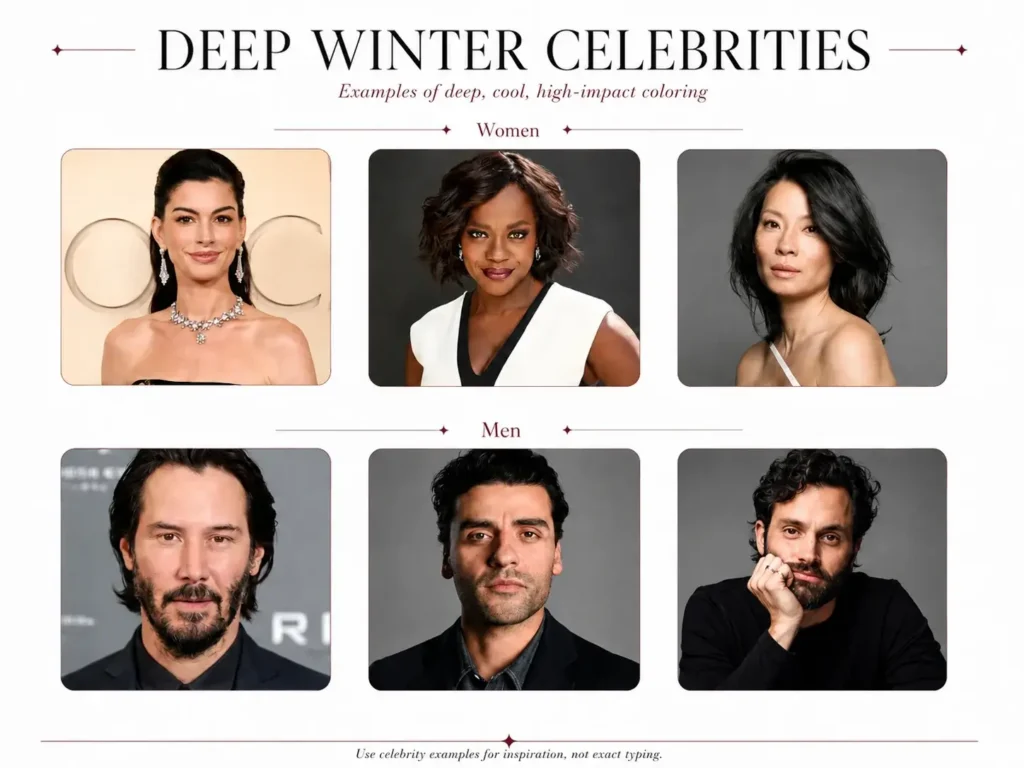
Celebrity examples can be useful for understanding Deep Winter because the season looks different across skin depths, hair colors, and contrast levels. Still, celebrity typing is never absolute. Photos, makeup, hair dye, lighting, and editing can change how someone appears, and trained analysts generally treat celebrity seasons as visual references rather than confirmed typings.
Among women, Priyanka Chopra Jonas, Anne Hathaway, Viola Davis, Kim Kardashian, Lucy Liu, and Selena Gomez are commonly cited as Deep Winter examples. These women show how broad the season can be. What connects them is not one specific skin tone or eye color, but an ability to carry substantial, cool-leaning colors without disappearing behind them. Like black, charcoal, deep navy, berry, burgundy, emerald, cool red, and other saturated dark shades. Salma Hayek, Nina Dobrev, Sandra Bullock, and Jodie Turner-Smith are also listed as possible Dark Winter.
For men, useful Deep Winter references include Djimon Hounsou, Keanu Reeves, Simu Liu, Oscar Isaac, and Adam Driver. Other include Colin Farrell, Trevante Rhodes, Robert Downey Jr., and Kit Harington in or near the Dark Winter family. Their coloring varies considerably, but deep navy, charcoal, black, cool burgundy, pine green, and crisp light-dark combinations tend to demonstrate the palette well.
Use celebrity examples for inspiration, not as a shortcut for typing yourself. The real question is if the same deep, cool-neutral, relatively clear colors improve your own face in consistent side-by-side comparisons.
Frequently Asked Questions
Is Deep Winter the same as Dark Winter?
Usually, yes. Different 12-season systems use different labels, but Deep Winter and Dark Winter generally refer to the depth-dominant Winter subtype. Exact palettes still vary between systems and analysts.
What is the main characteristic of Deep Winter?
Depth.
Deep Winter looks strongest in the deeper, more intense part of the Winter palette. Deep types as best in the darker and more intense shades of their base season.
Is Deep Winter warm or cool?
It belongs to Winter, so it leans cool.
But it sits next to Deep Autumn, which means some Deep Winters can tolerate more warmth than Cool or True Winter.
Can Deep Winter have olive skin?
Yes. Olive is directly included in Deep Winter skin descriptions. Olive also does not automatically mean warm.
Can Deep Winter wear brown?
Yes. Start with:
Black-brown
Espresso
Brown-burgundy
Deep neutral chocolate
Lighter golden browns are generally harder.
Can Deep Winter wear beige?
Beige is harder near the face because many beige shades are light, warm, and muted.
If you want a light neutral, try:
Stone
Pewter
Taupe
Soft white
A deeper neutral taupe can work better than a yellow-beige.
Can Deep Winter wear gold?
Some can. Silver, platinum, and white gold are easy starting points, but gold is not automatically excluded. Test it against your actual skin.
Can Deep Winter wear pastel colors?
Yes, but icy and crisp lights are generally stronger than dusty pastels. Try icy pink, icy grey, icy violet, mint, or icy green.
Can Deep Winter wear pure white?
Yes. Pure white is one of its strongest light neutrals. Soft white is also available if optic white feels too hard.
Can Deep Winter wear all black?
Yes, but you do not have to. If black feels flat, add:
White
Raspberry
Red
Turquoise
Emerald
Silver
or replace some black with charcoal or navy.
What is the best Deep Winter neutral?
Charcoal is probably the most flexible single option.
For a complete neutral base, use:
black + charcoal + navy + white
What colors are hardest for Deep Winter?
The most difficult group tends to be light, warm, and muted colors such as peach, golden beige, camel, pale orange, and some dusty earth tones.
A color does not have to fail simply because it is warm, though. Depth can make certain crossover colors much more workable.
Final Takeaway
Deep Winter makes much more sense once you stop treating it as a list of black clothes and jewel tones.
The order matters:
Depth first.
Then look at temperature.
Then chroma.
Then contrast.
Your strongest wardrobe will usually contain deep neutrals such as charcoal, navy, black, pewter, espresso, and black-brown, plus substantial colors such as cranberry, burgundy, aubergine, raspberry, pine, emerald, teal, royal blue, and true red.
Use pure white and icy colors when you want lightness.
Use charcoal, navy, aubergine, or pine when black feels repetitive.
And do not automatically reject brown, olive, tomato red, rust, or gold. Deep Winter sits beside Deep Autumn, so some crossover is part of the palette rather than a mistake.
Most importantly, stop asking only:
“Can Deep Winter wear this color?”
Ask:
What version of the color is it?
Is it light or deep?
Clear or dusty?
Cool, neutral, or strongly warm?
How much contrast does it create?
Is it beside your face or on your shoes?
Those questions tell you much more than the color name ever will.
Your Deep Winter palette should help you read color better. It should not make your wardrobe smaller.